
If you don’t follow British higher education news, there’s no reason you’d know the name Jason Arday (and if you do, you probably know enough for this introduction to be redundant). Arday, a celebrated sociologist, resigned his chair at Cambridge, weeks after a plagiarism allegation prompted public scrutiny of a decade of claims about his biography.
I’m asking a readership of language teachers and applied linguists to spend a few minutes on it anyway, because the story underneath the scandal isn’t really about Cambridge, or sociology, or even higher education specifically. It’s about what happens when every institution with the standing to catch a problem early finds a reason not to —a jurisdictional excuse, a confidential process, a legal threat— and someone far less accountable moves into the space they vacate.
Why I hesitated,
and why I must talk
I have written before about cases of academic integrity, Baumann among them, without much second-guessing. This one felt different, and it took me a while to understand why. I told myself that things that indignated me in the past seem less outrageous as you grow older. “This case is more sensitive”, I thought. I realise that such thinking was really making excuses. What makes things different is that I no longer write from nowhere. I represent a university, I co-edit a journal, I lead funded projects with partners across several countries, and every one of those affiliations sits, unstated, behind anything I say about how higher education handles credentials, race, and merit. For a while, that felt like a reason to leave this one alone.
But silence has a cost too, and in a field that studies language, credentialing, and institutional discourse, staying quiet on the clearest recent case of all three colliding starts to look less like prudence and more like abdication. The obligation of anyone who writes publicly from inside institutions isn’t to pretend the stakes don’t exist. It’s to name them and proceed anyway, carefully.
Edward Said, in the fourth of his Reith Lectures, drew a distinction that still seems relevant: he contrasted the intellectual as amateur, whose commitments come from care rather than career, and the intellectuals as professionals, who learn –over time and through unnoticed domestication– to trim what they are willing to say to fit what her institutions can comfortably absorb. I’d rather risk the discomfort than this kind of drift into professionalism.
Rather, the danger comes from an attitude that I shall be calling professionalism, that is, thinking of your work as an intellectual as something you do for a living between the hours of nine and five, with one eye on the clock and another cocked at what is considered to be proper professional behaviour: not rocking the boat, not straying outside the accepted paradigms or limits, making yourself marketable and –above all– presentable, hence uncontroversial and unpolitical and objective.
Edward Said. (1993). Professionals and Amateurs. BBC.
What actually happened
Stripped of the noise, the sequence of events that led to Jason Arday’s demise is fairly linear. Arday had become, by wide report, the youngest Black professor at Cambridge, appointed at 37 to a chair in the sociology of education, with an origin story that ticked the boxes of dyslexia, autism, and more.
In recent months, however, that story came under sustained scrutiny. The Times published an analysis of his 2015 doctoral thesis identifying passages closely resembling earlier published work. Two of his journal articles required post-publication corrections. A series of biographical claims, including marathon-running feats and visiting professorships, were disputed and walked back. Arday has denied wrongdoing and described the campaign against him as racially motivated (a point that seems, at least partly, defensible). He eventually resigned his Cambridge chair in early August, as the university opened a formal investigation.
What’s notable is less the individual allegations, some of which remain contested, than how each institution with the standing to look into them chose not to. I’ll come back to that in a moment. It’s also worth noting, without yet unpacking it, that the person who brought the plagiarism allegations to public attention was Nathan Cofnas, a philosopher whose affiliation with Emmanuel College was severed in 2024 over his own writing on DEI. I want to give him a section of his own rather than a footnote, because I think the easy reading of his role is unhelpful.
Before I do any of that, however, I need to be explicit about my own starting points and trust that readers will not read my views on the case as evidence of an agenda that’s quietly steering the argument from underneath, unstated.
Where I stand on DEI
When it comes to DEI, I hold a fairly conventional position, and I don’t think holding it carefully requires apologising for it. I believe that among equally qualified candidates, institutions should prefer the underrepresented one. I don’t think this is a controversial claim among people who take structural disadvantage seriously, and —while Claude cautions me that this is a sentence that could be taken out of context and used against me– I’m not interested in pretending otherwise for the sake of appearing balanced.
What I do think deserves more honesty than it usually gets is how quickly the principle stops being straightforward once we leave the simplistic thought experiment, which juxtaposes privileged candidates with an underprivileged one, with perfectly equal credentials.
Underrepresentation isn’t one axis; it’s several, and they don’t stack cleanly. If a queer white candidate and a straight Latino candidate are both, on paper, equally strong, there is no algorithm that resolves who the “more underrepresented” candidate is. And it is just as problematic to translate measurable variation into meaningful difference: does a decimal difference in IF mean that candidates are unequally qualified?
Acknowledging that this is genuinely hard is not the same as concluding the underlying principle is wrong. It means the principle needs institutions willing to make hard, case-by-case judgments rather than apply a rule. And that, I’ll argue, is exactly the kind of hard work higher education has consistently avoided.
A systemic failure,
not an individual one
Looking at the Arday case, the core of the problem seems to be that this difficult process of genuine evaluation was replaced by a more mechanistic one.
Every institution with a chance to prevent the Arday situation from reaching monumental proportions earlier failed to do so effectively, and the pattern across these choices is the actual scandal.1 Liverpool John Moores University conferred Arday a doctorate in 2015 despite the overlaps now documented, and when the university revisited the question a decade later, a confidential internal procedure concluded the PhD stands. Two journal articles, corrected in 2018 and 2020 for sourcing problems, had passed through editorial screening and peer review without triggering a careful look at the underlying work. Cambridge, when first approached, said that the issues predating Arday’s appointment fell outside its remit (despite having hired him substantially on the record now in question), and was quick to dismiss queries as ‘racially motivated’. And Times Higher Education shelved an earlier investigation after receiving a letter from a defamation firm acting for Arday.
None of these actors is straightforwardly a villain of the piece, and I don’t think that’s the useful frame. What they share is a common reflex: each chose the response that was legible, bounded, and low-cost over the one that was slow, uncomfortable, and structural. That reflex, repeated across five separate gatekeepers, is what I mean by systemic failure. And here’s why it is dangerous:
When the people whose job it is to implement safeguards decline to implement them, the space they vacate doesn’t stay empty. Somebody else fills it, on their own terms, and usually without the institutional accountability the first group was avoiding. Which brings me back to Nathan Cofnas…
Cofnas: wrong, not a villain
Nathan Cofnas writes as someone who regards himself wronged, as an individual and as a member of a race. This has led him to publish views on race and academic representation that I find indefensible,2 and nothing about his role in surfacing the Arday allegations changes that assessment. But I find it analytically useful to keep three things distinct: his feeling of indignation against perceived injustice, the epistemic frame he deploys to make sense of this (and the ways forward that flow from it), and his role in the Arday case specifically.
The question I find most pressing is how someone with real intellectual tenacity, sufficient to run a plagiarism-detection analysis nobody else had bothered to do, ends up channelling that tenacity into a worldview that –to my eyes– is genuinely harmful. I don’t read this as a personal failing so much as a pedagogical one. That is, to be clear, a claim about the aetiology of the case, not about exoneration: knowing how someone arrived at a view is useful, I think, even if it doesn’t change the appropriate response to it.
Higher education seems increasingly preoccupied with rewarding sharp, independent minds and is becoming progressively worse at coupling such sharpness with the ethical commitments that should constrain what such a mind does. Cofnas, on this reading, isn’t an exception to the systemic-failure thesis. He’s a second symptom of an institutional culture that appears better at cultivating analytical independence than at fostering reflection on how that independence is exercised.
But we are digressing: on the plagiarism case, I must be unambiguous: the plagiarism-detection work was careful, and it has held up under scrutiny from independent reviewers with no stake in his broader arguments. Whatever else is true of Cofnas, he got this one right.
Optics versus access:
DEI’s deeper shortcut
And here’s the uncomfortable part: Cofnas is also right in his criticism of DEI practices if standards are applied unevenly. I cannot comment on whether this happened in the Arday case, or on how DEI procedures work across the industry. However, there’s a reason a single high-profile appointment carries so much institutional weight, and it’s the same reason nobody wants to touch the harder problem underneath it. A symbolic diversification is a cheap,3 fast, and legible outcome to which a university can point and claim that it has done its job. It is efficiency without regard for consequences, Reid’s professionalism at work. Actually expanding who gets access to higher education, on the other hand, is expensive, slow, and diffuse, and no single decision-maker gets to claim credit for it.
That’s the shortcut that the current institutional form of DEI can take. Faced with a scarcity of seats, universities have optimised who fills the visible ones rather than asking why the seats are so scarce. The honest version of the underrepresentation problem cannot be “who among these finalists should get the job”; it must be to challenge the bottleneck by asking “why is there just one job for several very strong candidates?” The same is true further down the pipeline: rather than fight over limited scholarship, perhaps we should be asking why the current fee structure has made scholarships necessary.
I’m not going to pretend that funding more posts and places is straightforward, particularly against the current UK higher education climate; it plainly is not. But we do need to be honest about the nature of the problem, which is about capacity, not just selection, and about widespread rationalities, not just singular decisions.4
Closing Thoughts
Put side by side, the failure to properly vet Arday’s record before elevating him to a flagship appointment, and the failure to couple Cofnas’s intellect with democratic values before he turned it toward scholarship most of us (hopefully) reject, look less like two unrelated scandals than one institutional habit wearing two faces. Higher education keeps reaching for the fix it can see and point to, and keeps declining the one it would actually have to build.
I didn’t want to write this. I’m still not entirely comfortable having written it, given who I write as. But a discipline that studies institutional discourse doesn’t get to sit out its clearest current example, and staying silent felt, in the end, like its own kind of shortcut.
By subscribing to this blog, you will receive occasional updates on topics relating to language education, including my ongoing work on AI in language teaching and learning and on the research literacy of language teachers. (privacy policy)
Notes
- Does it mean that this is their fault? Asimov’s Naked Sun comes to mind, where a robot pours its master a glass of water, another one pours some poison in it, and a third one serves it – did any robot violate the First Law of Robotics (A robot should not knowingly harm a human)? GEM Anscombe would argue institutions, especially those where legal and ethical expertise abounds, must be accountable for the foreseeable consequences of their actions. ↩︎
- To be very transparent, I do not have first-hand knowledge of his work on ‘race realism’, except as reported in the press. I am uncomfortable with explanatory frames that connect biological variation and social outcomes, and with work that flattens complex phenomena into ‘realism’. I understand how analytical nuance may be lost in the transition from academic writing to mainstream media and political discourse, and I will concede that my views on his work are probably partial (in both senses) and perhaps uncharitable. However, I am not inclined to debate any of this here, because nothing in the argument I make depends on my having characterised his scholarship perfectly. ↩︎
- Well, maybe not cheap, at least not in the sense that either the selection process or the salary of a tenured professor are trivial. Perhaps it would be more accurate to say that it is ‘fixing representational metrics is not as expensive as structurally expanding academic opportunity’, but I wasn’t able to fit it in this paragraph. ↩︎
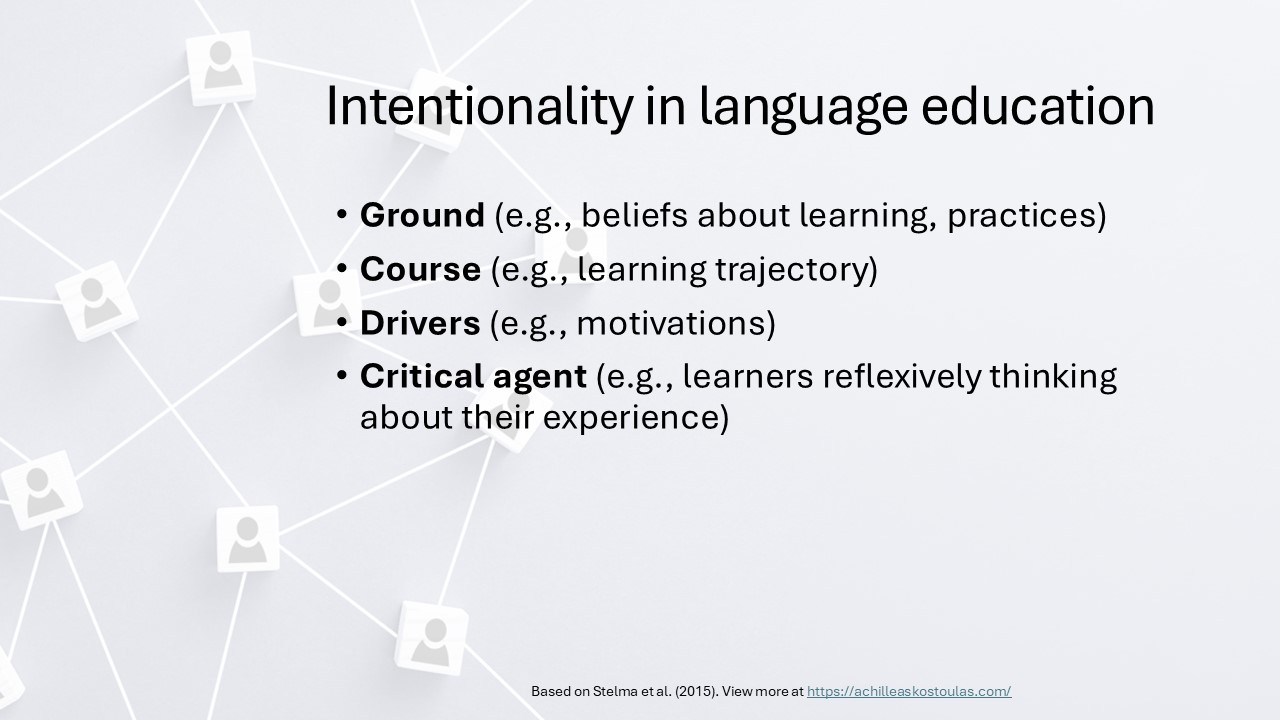
- The word ‘just’ is important here. Systemic problems do not absolve us of individual responsibility. Arendt’s warning is useful here: “where all are guilty, nobody is.” My own work on intentionality and the relation between structure and agency may be relevant, too. ↩︎

August 2026: Notes on Naming and Making Things Visible
A reflective look back at August 2026: publications finally appearing, research projects taking shape, books read, journal work, and the less orderly reality behind a seemingly productive academic month.


The Knowledge Infrastructure Language Education Never Built
Language teachers generate potentially useful knowledge every day, but much of it never travels beyond the classroom. What might language education learn from other professions about transforming individual experience into shared professional knowledge?

Intentionality, Language Education and Complex Dynamic Systems
This post introduces intentionality, a concept that helps us rethink how complex dynamic systems are constructed in language education research.

About me
Achilleas Kostoulas is an applied linguist and language teacher educator at the Department of Primary Education, University of Thessaly, Greece. He holds a PhD and an MA in Teaching English to Speakers of Other Languages from the University of Manchester, UK and a BA in English Studies from the National and Kapodistrian University of Athens, Greece.
His research explores a wide range of issues connected with language (teacher) education, including language contact and plurilingualism, linguistic identities and ideologies, language policy and didactics, often using a Complex Dynamic Systems Theory perspective to tease out connections between them. Some of his work includes the research monograph The Intentional Dynamics of TESOL (2021, De Gruyter; with Juup Stelma) and the edited volume Doctoral Study and Getting Published (2025, Emerald; with Richard Fay), as well as numerous other publications.
Achilleas currently contributes to several projects that bring together his long-standing interests in language education, teacher development, and the social dimensions of language learning. As the coordinator of the AI Lang (Artificial Intelligence in Language Education) expert team at the European Centre for Modern Languages of the Council of Europe, he is active in developing principles and resources to help educators make informed, pedagogically grounded use of AI in their teaching. He also leads the University of Thessaly team of ReaLiTea (Research Literacy of Teachers), a project that supports language teachers to engage with, and contribute to, educational research. Alongside these, he contributes to LocalLing (Revitalisation of Linguistic Diversity and Cultural Heritage), a Horizon-funded initiative for the preservation of heritage and minority languages globally.
In addition to the above, Achilleas is the (co)editor-in-chief of the European Journal of Education and Language Review, and welcomes contributions that explore the dynamic intersections between language, education, and society.
About this post
This blog is a space for slow, reflective thinking about applied linguistics, language education, professional development, and the role of technology in language teaching and learning. Transparency about process, tools, and authorship is part of that commitment.
- I wrote this post on 10 August 2026. I will periodically revise it to ensure accuracy, so feel free to point out any issues that come to your attention.
- When writing this post, I used artificial intelligence to support copy-editing and to identify passages that might be unclear or vulnerable to decontextualisation. I wrote the text, and retain responsibility for analytical thinking, authorial decisions and wording.
- The views expressed here are personal and do not reflect those of the University of Thessaly or any other entity with which I am affiliated.
- The featured image, by mnirat, is licensed from Adobe Stock.

Leave a Reply