
When I write these posts, the opening paragraph is the one that gets written last. Often, it’s easier to notice the patterns in what I’ve been writing once the text is on the screen, and then I go back and write an opening as though I’d known it all along. Patterns don’t announce their coherence in advance, this is something a mind applies retrospectively, once it decides to look at the aftermath of writing (and living?) as a shape rather than a blur. The month doesn’t have a theme; I give it one, after the fact, by deciding which parts count as pattern and which as noise.
Looking back at August, the pattern I’m tempted to impose is one of things gradually taking shape. Publications that had been sitting in various stages of production moved closer to print. Projects that have occupied much of the past few years are beginning to look less like collections of unfinished documents and more like things we might actually deliver. Ideas encountered in books, conversations, and other people’s work seem to have emerged, uninvited into my writing. Even some of the less comfortable parts of the month have left traces that are difficult to regard as merely incidental. Whether this amounts to a genuine pattern or simply a story I am telling myself at the end of August is, of course, another question. But then again that’s what these monthly posts are mostly for.
Publications
Publications are, in a way, like buses: you wait and wait, and then two or three just come together.
Learning Modern Greek
This month, I was pleased to finally get a copy of Analyse contrastive et didactique des langues étrangères [Contrastive analysis and Foreign Languages Teaching], a collection edited by Freiderikos Valetopoulos, which carries a chapter by Eleni Motsiou and myself. Our contribution, entitled When Modern Greek and Russian meet: Teachers’ perspectives on learning challenges outlines difficulties encountered by speakers of Russian who are learning Modern Greek. This chapter took a while to make it to press (we did the data collection in 2024), but was one of the most enjoyable I remember writing, not least because of the amusing nature of false friends and phonological infelicities.1
Complex systems in Language Education
I also just sent out the final copyedited version of a short entry I am writing for the Elgar Encyclopedia of Complexity (edited by Eve Mitleton-Kelly), which should be out in the coming months. It’s a short article, but it does some important theoretical work.
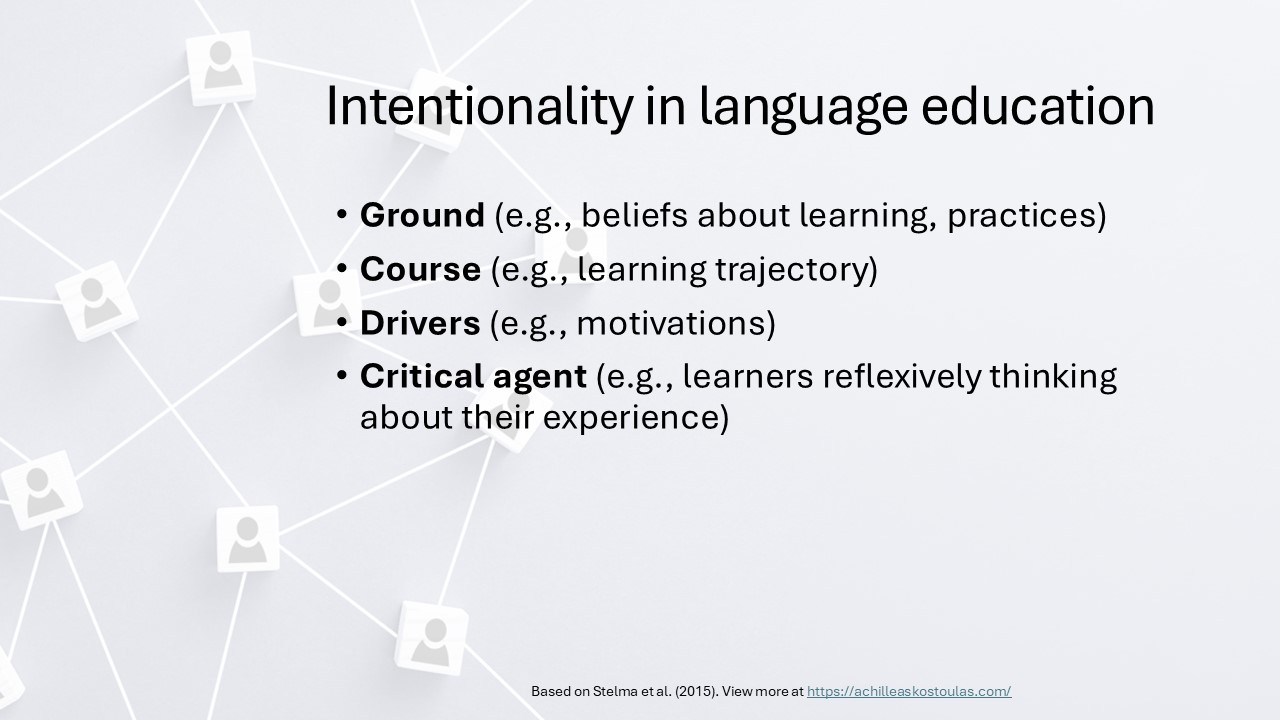
In the entry, I reiterate the point that Complex Dynamics Systems Theory works best as a metatheoretical explanation (a ‘theory of theories’) that can give some coherence to our thinking about language education. The other point I make, which is also important I think, is that defining complex systems is a mental framing move (these systems do not ‘exist’ in the real world in the sense that Zimtschnecken, redheads, and the mighty 4.2” exist), and that they are defined by their intentionality (the ‘thing’ about which the mental construct is). This is, I believe, a rather elegant way to challenge naive realism in our thinking about language education, without conceding to the extremes of epistemic relativism.
Epistemic Justice and Critical Research Literacy
The third publication I sent out this month was a contribution, with Sofiá Tsioli, to the proceedings of the 6th International Conference “Literacies and Contemporary Society: From Skills to Practices”. Again, this is an unassuming little publication, but it is important to me because, among other things, it sets in print Sofiá’s conceptualisation of epistemic justice in research engagement, as a composite of data justice, linguistic justice, citational justice, and socio-environmental justice. There are few redeeming qualities in being an academic, but being surrounded by clever people who have interesting ideas is a privilege.

Ongoing research projects
I imagine that I am not the only academic who ever hoped to catch up on their research commitments during the summer, and I certainly am not the only one who failed. Still, I did manage to get some work done, paving the way for what I hope to be good progress in the coming weeks.
ReaLiTea
The focus of my work in August was the Research Literacy of Teachers project. During these months, my team and I managed to revise the bulk of the self-study materials for engaging with research (see below). This involved attending to the useful feedback we received from our critical friend, updating resources, and ensuring consistency across modules. I expect that these materials should be available for sharing by the end of next month.
ReaLiTea Learning resources
for effective engagement with research
- Drawing on published professional knowledge
- Locating relevant knowledge to inform language education
- Engaging with journal articles (and beyond)
- Critical reading and evaluation of publications
- Alternative ways of communicating research in language education
Another important development is that we have added a new (beginner) level to our Research Literacy framework. We believe that this better captures the research literacy of teachers at the beginning of pre-service education. In a sense, this was always there, just as a 0 is there in the sequence of numbers 1, 2, 3…, and I had originally believed it to be unnecessary, because the framework pointed towards developmental goals. On more careful reflection, being able to record one’s current level of development, even at a very initial stage, is useful too. To distinguish between this revised version of the framework and the one we validated in Kostoulas et al. (2025), we call this the 2nd edition.
At the moment, we are actively planning the next Transnational Meeting of the project team, which will bring the ReaLiTeam to Volos. Among other things to look forward to in this meeting is the possibility for an online Research Literacy conference. More on this to follow in later posts.
LocalLing
For the Revitalisation of Linguistic Diversity and Cultural Heritage project, the past few months have continued to build on the momentum created during the Volos LocalLing meeting. By now, we have already completed 19 secondments across our consortium, and I am looking forward to welcoming another group of colleagues from Cameroon, Togo, and Morocco to Greece in September.
Pleasingly, our edited collection, where we present the linguistic ecologies in the countries of the consortium members is also moving along quite well (despite the timetable challenges that such projects invariably involve). What I find most interesting is that, in addition to their descriptive content, all the chapters seem to be making some kind of theoretical contribution to the study of linguistic diversity: the concept of unibilingualism suggested by our Colombian partners to describe exclusionary and reductive bilingualism, Dominant Multilingual Constellations described in the Tunisian chapter, and linguistic dominance, as described by the Greek team, are just a few examples.
AI Lang
The ECML-funded Artificial Intelligence for Language Education project is gradually moving towards the point where we will actually deliver our deliverables, and it is pleasing to note that both our Guidelines and our Moodle course are nearing completion. I spent some of the last weeks preparing a set of case studies that exemplify the guidelines, which we will include in our publication.
AI Lang guidelines
I. AI use in language education should be safe
- Comply with existing legal requirements and institutional standards.
- Safeguard the data security and digital safety of all participants.
II. AI use in language education should be responsible
- Promote social justice and linguistic and cultural diversity.
- Foster environmental sustainability.
III. AI use in language education should be purposeful
- Enhance theory- and policy-informed language teaching pedagogy.
- Create expanded language learning opportunities.
IV. AI use in language education should be human-centred
- Prepare learners for critical, healthy engagement with AI.
- Empower language teachers as reflective professionals.
We are also now in the stage where we can slowly begin standardising and copyediting our other flagship deliverable, the Moodle course, as well as producing its French version. When that happens, we will not be able to make any other changes, so if you have any input to share, feel free to do this now.
With our next expert team meeting coming up in early September, I am looking forward to seeing these deliverables continue to take shape.
Readings
One thing I do enjoy when I get a respite from commuting and teaching is that I do find more time for reading. Some of the books that finally made it from the night-table to the bookshelf this month included Miranda Fricker’s (2007) book on epistemic injustice, a concept that I knew from second-hand accounts, Rethinking education policy by the late Bernard Spolsky (2021), which is an incremental improvement over the original (2004) volume, and G.E.M. Anscombe’s Reminiscences of a philosophical friendship [with Wittgenstein], which comes with a set of well-written companion chapters by John Berkman and Roger Teichmann.2
However, the book I most enjoyed was The scientist’s guide to writing by Stephen Heard,3 which I revisited before handing it over to my daughter who is now a Year 1 undergraduate.4 What I appreciated about the book was not just its thoroughness (chapters include advice on selecting journals, reviewing and responding to reviewers, and the place of beauty and humour in academic prose), but the sheer elegance of the text:
The key to coping with writer’s block is to understand that it’s poorly named. A block sounds like an obstacle imposed to you from the outside: a concrete barrier across the roadway. But really, writer’s block comes from inside the writer. It’s the perception of obstacles, or at least the failure to see ways around them, that holds a blocked writer back.
Heard, S. B. (2016). The scientists guide to writing (2nd edn., p. 51). Princeton University Press.
Calls for Papers
If the quote above has inspired you to write, but you’re not sure where to submit your work, a number of interesting options has come up in the last few weeks.
- One is a special issue in Second Language Research & Practice, edited by Lucian Rothe and Luis Javier Pentón Herrera. This is entitled “What or who are we doing this for? Innovative perspectives on motivations, struggles, and futures of teaching languages other than English in the United States”, and the editors welcome both research articles (up to 8,500 words) and praxis reports (up to 5,000 words), an often overlooked genre in language education. [Link to call for papers]
- Another publication to look forward to is the collection Decolonial Turns in TESOL Research: Epistemologies, Methods and Pedagogies, edited by Leonardo Veliz, Waqar Ali Shah, and Suresh Canagarajah. According to the editors, the volume aims to “intervene in ongoing debates about knowledge production in TESOL research by critically interrogating the epistemological and methodological orthodoxies that continue to shape the field.” [Link to call for abstracts]
- Lastly, Leonardo Veliz, Paul Meighan, and Waqar Ali Shah are putting together an article collection entitled Reimagining “quality” in multilingual education: Ecologies, practices and possibilities, which may be of interest to some. [Link to call for proposals].
And as a reminder, we are always open to receiving your work that challenges established ways of thinking about language and education at the European Journal of Education and Language Review.
Submit your work to the EJELR
The European Journal of Education and Language Review, a diamond open-access journal, publishes research that unsettles assumptions about how languages are taught, valued, and used as instruments of power. We seek work at the intersection of language, ideology, and social structure: rigorous, original, and unafraid to question orthodoxies. We give particular priority to theoretical and methodological innovation, research on languages whose speakers and scholars are underrepresented in mainstream scholarship and critical perspectives that illuminate the political and ideological dimensions of language education. Do you believe your work belongs here? Click on the button below to read more.
Journal updates
Speaking of the journal, I am proud to announce the publication of two more articles (we have a continuous publication format, which means that articles appear shortly after acceptance). The first one, by Timothy and Anita Gjini, focuses on how AI-mediated recruitment practices impact the educational and career trajectories of international students, and the other one, by Bahram Kazemian, Shafigeh Mohammadian, Shatha Naiyf Qaiwer, uses a Hollidayan perspective to look into Donald Trump’s rhetoric. In a somewhat understated way, Kazemian et al. (2026) draw our attention to the fact that:
These patterns are consistent with broader research on political discourse, yet they exhibit distinctive characteristics that reflect Trump’s unique rhetorical approach.
Kazemian et al. (2026, p. 15).
Also accepted, but not yet published, we have an interesting study by Marc Jones and Gretchen Clark on the experiences of language teachers with ADHD.5 More on this when it’s published.
Not particularly consequential, but rather baffling, has been the experience of watching two journal articles come to a halt within touching distance of publication. Both have been accepted, neither requires another round of peer review, and all that stands between them and publication is a relatively straightforward revision. And yet their authors seem to have disappeared. There is something peculiar about editorial work in these moments: after months of reviews, correspondence and revisions, the editor can do almost nothing except send a final reminder and watch an otherwise viable publication go into the archive. I am not sure why it happens, but sometimes all you can do is let go.
From the blog
Thinking of my own writing, I have been reasonably productive on the blog over the last month (the joys of not having to commute!). In case you missed them, the latest posts included a report on a podcast by Maria Cioé-Peña (another one of our expanding ReaLiTea resources), who reminds us that there’s more to inclusive education than merely providing learners with content translated into their L1s, some thoughts on the Arday case as a symptom of widespread dysfunction in higher education, a theoretical post where I discuss intentionality in complex dynamic systems, and some reflections on what I describe as a ‘missing middle‘ between research publications and practice in language education.

Intentionality, Language Education and Complex Dynamic Systems
This post introduces intentionality, a concept that helps us rethink how complex dynamic systems are constructed in language education research.


Two Failures, One Habit: On the Arday Case
The Arday scandal is about more than plagiarism and DEI. It reveals what can happen when institutions leave difficult questions and accountability to those who will answer them on their own terms.

Inclusion beyond translation: A conversation with Maria Cioé-Peña
What can a teacher do when thirty children bring different languages, cultures, and needs into the same classroom? Drawing on a ReaLiTea podcast, this post considers culturally sustaining pedagogy, multilingual ecologies, multimodal meaning-making, and the unresolved gap between inclusive principles and classroom practice.

The Knowledge Infrastructure Language Education Never Built
Language teachers generate potentially useful knowledge every day, but much of it never travels beyond the classroom. What might language education learn from other professions about transforming individual experience into shared professional knowledge?
Behind the scenes
It’s difficult to look back to August, without thinking about the Arday case, which distressed me considerably. I don’t think I am quite ready to write about the intense anger and betrayal I felt when I realised that for many of us, including people whose work I respect, what I thought were core values seem to be readily abandoned when tribal loyalty makes them inconvenient.
So rather than write about that, I will contemplate what it has meant to work through another month, ostensibly a vacation, while battling small irritations: eye strain that is increasingly painful, caffeine-withdrawal headaches, realtors who are more annoying than they are helpful, and an apparently empty house that somehow consumed 48 kWh of electricity. None of this is especially remarkable, which is perhaps why it disappears so easily from retrospective accounts. Completed manuscripts, revised frameworks and books moved from the night-table to the bookshelf leave visible traces. The rest is noise. It is noise because we name it so, having decided what is important. Who knows, perhaps we even got it right.
Looking ahead
Looking ahead, the next few months have a number of nice treats coming up. Most imminently, this includes the two upcoming AI Lang and ReaLiTea meetings, as well as collaborations with our visiting LocalLing colleagues. And I also seem to have committed to two teacher training events, in Athens and Cyprus, in the next few weeks. As always, do come and say hi, if you’re around! Further ahead are a teaching foray to Heidelberg in October, a plenary speech in Southern Italy on heritage languages, and later in Spring, two more plenary speeches, in Canada and Italy, both focusing on AI. It’s not like I want to travel the world, but somebody must…
By subscribing to this blog, you will receive occasional updates on topics relating to language education, including my ongoing work on AI in language teaching and learning and on the research literacy of language teachers. (privacy policy)
Notes
- “Russian learners of Greek reportedly tended to interchange [o] and [a] sounds, producing morphologically acceptable but phonologically inaccurate and pragmatically inappropriate forms such as [kolo’ceri] (as opposed to [kalo’ceri]), [ska’tono] (rather than [sko’tono]), [xar’topita] (instead of [xor’topita]).” <– I am easily amused. ↩︎
- Which is where I learnt, among other things, that Anscombe smoked the nikotine equivalent of 200 cigarettes per day. ↩︎
- I understand that there’s a third edition now (2026), but the book I read was the second one. The second edition of my framework, the second edition of Spolsky’s book, the second edition of the Scientists guide to writing. I don’t know why ‘second editions’ seem to be such a persistent thread in today’s writing, but I do believe patterns in observable behaviour echo things in the subconscious. For a moment, I thought about giving this post a name that invokes this, and then it struck me – the underlying pattern today is about giving names… ↩︎
- Like I said, there are patterns everywhere that only become evident when you put things in words: they tell us why I refused to involve first year undergraduates in my thinking about the framework two years ago, and why they are more visible now, they tell you why the ‘point of no return’ idea had to surface in today’s writing about AI Lang materials. Positionality and reflexiveness at work, την επιστημική μου οξυδέρκεια μέσα. ↩︎
- One of the most impactful moments in my career was listening to Marc describe his experience as a teacher with ADHD, including a forceful plea for seeing neurodivergent teachers as researchers, not subejcts of research. ↩︎
You may also find the following posts of some interest

July 2026: Notes on Becoming, and Other Unfinished Business
Four book projects, two field trips, and a lot of unfinished business. Notes on teaching, research, and writing in July 2026.

April 2026: Notes on Fatigue and Unexpected Returns
Sustained effort, unexpected intellectual richness and occasional moments that make the work feel worthwhile. A summary of my work in April 2026.

March 2026: Notes on academic collaboration, strain, and scholarly direction
March 2026 was a month dominated by the kick-off meeting of the LocalLing project, perhaps the most important thing I’ve done in my academic life. This is how it unfolded.

About me
Achilleas Kostoulas is an applied linguist and language teacher educator at the Department of Primary Education, University of Thessaly, Greece. He holds a PhD and an MA in Teaching English to Speakers of Other Languages from the University of Manchester, UK and a BA in English Studies from the National and Kapodistrian University of Athens, Greece.
His research explores a wide range of issues connected with language (teacher) education, including language contact and plurilingualism, linguistic identities and ideologies, language policy and didactics, often using a Complex Dynamic Systems Theory perspective to tease out connections between them. Some of his work includes the research monograph The Intentional Dynamics of TESOL (2021, De Gruyter; with Juup Stelma) and the edited volume Doctoral Study and Getting Published (2025, Emerald; with Richard Fay), as well as numerous other publications.
Achilleas currently contributes to several projects that bring together his long-standing interests in language education, teacher development, and the social dimensions of language learning. As the coordinator of the AI Lang (Artificial Intelligence in Language Education) expert team at the European Centre for Modern Languages of the Council of Europe, he is active in developing principles and resources to help educators make informed, pedagogically grounded use of AI in their teaching. He also leads the University of Thessaly team of ReaLiTea (Research Literacy of Teachers), a project that supports language teachers to engage with, and contribute to, educational research. Alongside these, he contributes to LocalLing (Revitalisation of Linguistic Diversity and Cultural Heritage), a Horizon-funded initiative for the preservation of heritage and minority languages globally.
In addition to the above, Achilleas is the (co)editor-in-chief of the European Journal of Education and Language Review, and welcomes contributions that explore the dynamic intersections between language, education, and society.
About this post
This blog is a space for slow, reflective thinking about applied linguistics, language education, professional development, and the role of technology in language teaching and learning. Transparency about process, tools, and authorship is part of that commitment.
- I wrote this post on 30th August 2026. I will periodically revise it to ensure accuracy, so feel free to point out any issues that come to your attention.
- When writing this post, I used artificial intelligence to support copy-editing and Search Engine Optimisation. I wrote the text, and retain responsibility for analytical thinking, authorial decisions and wording.
- The views expressed here are personal and do not necessarily reflect those of the University of Thessaly or any other entity with which I am affiliated.
- Some links in this post are affiliate links. If you choose to buy a book from Amazon after visiting one of these links, Amazon will pay me a small commission (currently about 4.5%), at no additional cost to you. Amazon will, of course, know you came from here (which you may or may not find comforting). The commission helps support this blog: a small transfer from a billionaire’s pocket to the costs of keeping this space going. Alternatively, and always encouraged, please consider supporting an independent bookstore.
- The featured image, by mozZz, is licensed from Adobe Stock.

Leave a Reply