This year’s theme for the European Day of Languages, on 26 September 2026, is Languages unite! As a slogan, it does its work well. But slogans are, by definition, compressed arguments, and I often find there is value in unpacking them and examining their underlying assumptions.1 The one I would especially like to interrogate today is that we all mean the same thing when we talk about “uniting”. If this seems like an odd thing to question, I would like to draw attention to how ‘uniting’, the meeting of languages, happens through a mechanical intermediary that is increasingly present and less and less noticed: A growing share of our linguistic lives passes through machines that were not built with all languages in mind.
In this post, I would like to take a look at what this suggests, to me at least, and how we may approach it through the lens of the values that the European Day of Languages celebrates.
Interrogating “Uniting”
Uniting, on uneven ground
In the world in which I grew up, when people met across languages, this involved either one learning the language of the other or some kind of negotiated meaning-making that, in recent years, we have taken to calling ‘translanguaging’. There may have been an interpreter involved sometimes, adding an element of mediation and opacity, and the process was never inherently equal: it was often the less powerful who accommodated to the dominant languages. But the interaction was always distinctly human.
What seems different today is that technology has inserted itself into multilingual communication. This could be a translation app, a speech-to-text tool, a generative AI platform helping someone draft an email in a language they have not quite mastered, or a platform deciding which content to show them. These systems are very good at some languages and –as some of you may have noticed– considerably less good at others. This is hardly surprising: large language models, speech recognition and machine translation learn from data; they learn best when they have access to more data; but the data are unevenly distributed.2
Languages with large digital footprints, well-funded publishing industries and many online speakers are well represented. Regional and minority languages, and many migrant languages, are not. The same imbalance shows up in educational resources, in the voices available for text-to-speech, and in how reliably a system understands accented or code-switched speech.
Uniting, through the path of least resistance
Critical linguists can be irritating in their insistence to find clouds in every silver lining —the silver lining here being the celebratory discourse about AI and its enthusiastic adoption. After all, AI is hardly preventing users of minor, regional, heritage or displaced languages from using the languages they choose, and we would be missing the point if we relocated blame for language shift3 from people to technology.
What technology does is, simply, to make some languages more convenient than others. And convenience, repeated across millions of small decisions, has effects that prohibition rarely achieves. If the tool works better in English, the sensible thing is to use English; if the translation app I use to read an article written in Italian produces Greek that makes me cringe, I will adjust by switching to English as a default setting. Languages can “unite” in this sense too: by converging, gradually, towards the few that the infrastructure handles best.1
The irony does not escape me, that I am writing this in English, for a readership I reach more easily in English. That is, I think, a small, but not trivial, data point.
Convenience, repeated across millions of small decisions,
has effects that prohibition rarely achieves.
Uniting, but on whose terms?
It would be too easy to stop there, or continue along the same line; either approach would be unhelpful though. I will not pretend that the very technologies that I have been criticising in the previous paragraphs do not lower real barriers. A parent can now read a letter from their child’s school in a language they do not yet speak. A newly arrived student can follow more of a lesson than they could a few years ago (but see this discussion about how inclusion is much more than translation). A teacher can produce materials in a learner’s home language that she could never have written herself.
More importantly to the topic of the European Day of Languages, where tools exist, speakers of smaller languages can use them in domains from which they had been previously excluded, simply because nobody had the resources to translate the forms, subtitle the videos, or build the dictionaries.
So the question is not whether AI is good or bad for linguistic diversity. It is both, often at the same time. A more useful question is on whose terms the AI-mediated uniting happens: whether AI becomes a bridge that people cross in both directions, or a road that runs mostly one way.
The Council of Europe has been here before
I have been writing about the above as if it were an unprecedented situation in the history of languages. This is not quite the case, even though the questions I am putting before us seem to have become somewhat more urgent. The Council of Europe has, for some time, treated linguistic diversity and digitalisation as a single problem, rather than two separate ones.
In 2022, the Committee of Experts of the European Charter for Regional or Minority Languages adopted a statement noting that AI applications could support the everyday use of these languages, and encouraging states to include them in AI research and to work with their speakers on the appropriate use of such tools.
More recently, a Council of Europe study on minority-language protection pointed out that digital resources, such as machine translation and speech recognition, are becoming central to whether these languages have a future, and that it matters whether algorithms bring minority-language content to people who are not already looking for it.
What this positioning means, from where I see it at least, is that this policy does not view minority languages as recipients of whatever technology happens to arrive. Rather, it expects AI policy and development to include them from the outset. Put differently, linguistic equality is a design requirement, not as a courtesy extended post-hoc.4
The AI literacy recommendation
Earlier this month, the Council of Europe has given us something more concrete to work with. In September 2026, the Committee of Ministers adopted a Recommendation on artificial intelligence literacy (CM/Rec(2026)12), which calls on member states to promote AI literacy throughout their education systems, with particular attention to the professional development of educators. What I find most useful about it is that it treats AI not simply as a technology, but as a sociotechnical phenomenon, meaning that it draws attention to how AI reflects the choices of its creators and the dominant values of the society. On that view, being AI literate means understanding what AI does to society, not only how to operate the tools.5
The role of teachers
Policy statements matter, but at the end of the day, the people who can make actual change happen are the language teachers. The way they do this is by deciding what they ask learners to do with AI tools, which languages they will use to carry out their allocated tasks, and by being there to notice when a tool performs very differently depending on the language.
A teacher who asks students to compare a chatbot’s output in the language of schooling and in their home languages is doing something quite different from one who simply uses the tool in the dominant language because that is where it works best. Both are using AI. They are both teaching communicative skills. But only one is educating the students in the critical mindset that helps unmask the unevenness in the linguistic landscape.
The AI Lang project
This is, broadly, the territory in which we have been working with the AI Lang expert group at the European Centre for Modern Languages. Our interest is less in the tools themselves than in what language educators need to know, and to be able to judge, in order to use them in ways that are consistent with the plurilingual and democratic values the Council of Europe has long promoted. I will not summarise that work here, but the question in this post is very much one of the questions we keep returning to.
Unity as a task
For me, the best way to read Languages unite! is not as a description but as an imperative, the exclamation mark included. Languages do not unite people automatically; they do so when people, institutions and, increasingly, technologies make room for them. AI can help with that, or it can make the path of least resistance run steadily towards a handful of well-resourced languages. Which of these happens is not a property of the technology. It depends on choices, many of them small, many of them made by people who do not think of themselves as language policy makers at all. Teachers are among them.
By subscribing to this blog, you will receive occasional updates on topics relating to language education, including my ongoing work on AI in language teaching and learning and on the research literacy of language teachers. (privacy policy)
Notes
- I often remind my students that their job, in the university and beyond it, is to unsettle assumptions. This does not mean finding fault with everything they encounter for the sake of it (that’s not the kind of ‘critical’ we want). But it does means learning to notice what presents as obvious, natural or inevitable, and asking what might become visible if we looked at it differently. Languages unite! seems, at first glance, to be one of those statements that hardly needs interrogating, particularly on the European Day of Languages. And that is precisely why it we should pause and think: What does it mean for languages to unite? Who is doing the uniting, how, why and on whose terms? ↩︎
- There is, in fact, a recent paper comparing of large language models across high- and low-resource languages, which reports on a strong relationship between how well a model performed in a language and how much of that language was present in its training data (Li et al., 2025). In other words, the unevenness of the digital world finds its way into the capabilities of the models we build from it.
Li, Z., Shi, Y., Liu, Z., Yang, F., Payani, A., Liu, N., & Du, M. (2025). Language Ranker: A metric for quantifying LLM performance across high and low-resource languages. Proceedings of the AAAI Conference on Artificial Intelligence, 39(27), 28186–28194 ↩︎ - In an earlier draft of this post, this phrase was ‘language death’. On reflection, I think ‘language shift’ works better to describe is slower, less dramatic and equally saddening process: a narrowing of the domains in which a language feels like the “normal” one for certain tasks. That is harder to see, and that is –I would argue– part of the problem. ↩︎
- This is, I would argue, more important than it might at first seem, because in any infrastructure, decisions made early tend to become very hard to undo. ↩︎
- To be clear, the Recommendation is not specifically about language teaching. But it does ask us to understand the unevenness I have been describing. A teacher who asks students to compare a chatbot’s output in the language of schooling and in their home languages is teaching AI literacy in precisely this sense. ↩︎

European Day of Languages 2025: What Are We Really Celebrating?
Beyond posters and slogans, what does the European Day of Languages really mean? This post reflects on how we might move from symbolic recognition to genuinely sustaining the plurality of voices that shape contemporary Europe.


Every Language Is Someone’s World: Reflections on International Mother Language Day 2026
On International Mother Language Day, the real question is not which language we speak first, but what kinds of linguistic worlds we choose to protect.

International Mother Language Day 2019
Facts, figures and thoughts regarding linguistic diversity, globally and in Greece.

About me
Achilleas Kostoulas is an applied linguist and language teacher educator at the Department of Primary Education, University of Thessaly, Greece. He holds a PhD and an MA in Teaching English to Speakers of Other Languages from the University of Manchester, UK and a BA in English Studies from the National and Kapodistrian University of Athens, Greece.
His research explores a wide range of issues connected with language (teacher) education, including language contact and plurilingualism, linguistic identities and ideologies, language policy and didactics, often using a Complex Dynamic Systems Theory perspective to tease out connections between them. Some of his work includes the research monograph The Intentional Dynamics of TESOL (2021, De Gruyter; with Juup Stelma) and the edited volume Doctoral Study and Getting Published (2025, Emerald; with Richard Fay), as well as numerous other publications.
Achilleas currently contributes to several projects that bring together his long-standing interests in language education, teacher development, and the social dimensions of language learning. As the coordinator of the AI Lang (Artificial Intelligence in Language Education) expert team at the European Centre for Modern Languages of the Council of Europe, he is active in developing principles and resources to help educators make informed, pedagogically grounded use of AI in their teaching. He also leads the University of Thessaly team of ReaLiTea (Research Literacy of Teachers), a project that supports language teachers to engage with, and contribute to, educational research. Alongside these, he contributes to LocalLing (Revitalisation of Linguistic Diversity and Cultural Heritage), a Horizon-funded initiative for the preservation of heritage and minority languages globally.
In addition to the above, Achilleas is the (co)editor-in-chief of the European Journal of Education and Language Review, and welcomes contributions that explore the dynamic intersections between language, education, and society.
About this post
This blog is a space for slow, reflective thinking about applied linguistics, language education, professional development, and the role of technology in language teaching and learning. Transparency about process, tools, and authorship is part of that commitment.
- I wrote this post on 26th September 2026, to commemorate the European Day of Languages 2026. I will periodically revise it to ensure accuracy, so feel free to point out any issues that come to your attention.
- When writing this post, I used artificial intelligence to support copy-editing and Search Engine Optimisation. I wrote the text, and retain responsibility for analytical thinking, authorial decisions and wording.
- The views expressed here are personal and do not necessarily reflect those of the University of Thessaly or any other entity with which I am affiliated.
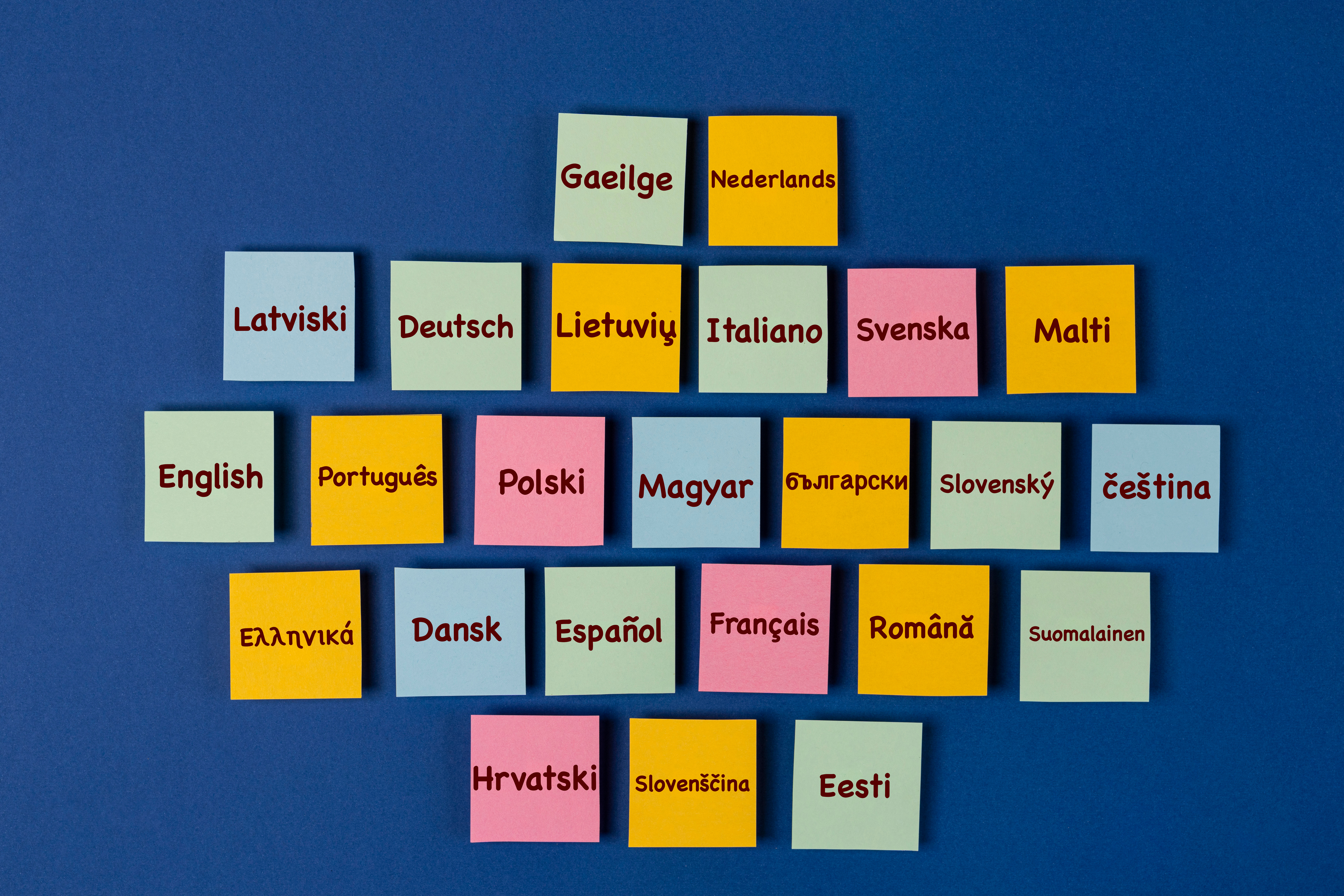
- The featured image, by Sergio Delle Vedove, is licensed from Adobe Stock. It represents the official languages spoken in the European Union, and lends itself for reflection on whether we are celebrating the European Day of Languages or Day of European Languages.

Leave a Reply