I am pleased to announce that Resistance to the Known: Counter-Conduct in Language Education, edited by Damian Rivers, and containing a chapter by myself, should by now be available for purchase (Palgrave Macmillan, Amazon, Blackwell). I have already written about the book and my contribution, so rather than reiterate, what I want to do in this post is recount the experience of getting my work published. Hopefully, this may be of some interest to readers who are interested in academic writing. What follows, then, is a step-by-step account of how this chapter came to be, interspersed with some advice and lessons learnt.
Finding a publication venue
I first became aware of the upcoming collection when someone forwarded me the Call for Chapters. A call for chapters (or papers, or contributions) is an invitation by the book editor(s) for prospective authors to contribute to a planned publication. Chances are that you will get a lot in your academic life, and you will need to think carefully which are worth your time – a finite resource.
In this case, I found that multiple themes in the Call for Chapters resonated with me. I liked the theme of questioning established practice (in my introduction to linguistics class, I often tell students that the purpose of research is to question givens). I also believed that in my doctoral research, which was beginning to take shape, there were several insteresting insights which could illustrate the argument that the editor was aiming to make.
So, with this in mind, my next step was to contact the editor and find out more about the collection he was putting together. I was particularly keen to know how definite the publication plans were, because I didn’t want to commit a paper to a book that might take years to appear in print. Here’s what my email looked like:
Dear Dr Rivers,
I was very interested to read your call for papers on Resisting the Known in FLE. I would be keen to have my work included in this volume, since my research involves understanding how English Language Teaching transitions between established pedagogical traditions, a global communicative orthodoxy and a post-modern, critical paradigm.
I was wondering if you might be able to give me some more specific information regarding the forthcoming publication: Have you negotiated a contract with a publisher, and is there a tentative date of publication at this stage?
Damian Rivers, the editor, replied swiftly, letting me know that he planned to negotiate a contract with an established publisher once he had a collection of promising abstracts at hand. This was not as encouraging as I had wanted to hear, but I did look up his CV and confirmed that he had considerable experience in putting together such projects, which I found reassuring.
Submitting an abstract
The next step towards getting published is submitting an abstract. An abstract is a summary of the paper you intend to write. It helps the editor and, eventually, book reviewers decide how well the proposed paper fits the planned publication (here’s a guide to writing abstracts, btw).
After my email exchange with Damian, I was quite keen on submitting to this particular volume, but I had two concerns. First, my research was not quite complete, and I had only a tentative idea of what my findings might look like when the time for writing came up. This made me rather nervous about committing my ideas to paper. Secondly, I was conscious that much of my conceptual work on complex systems theory (CST) could alienate readers, especially if I could only present it in a summarised form.
On account of these two risks, I ended up writing a fairly conservative abstract that stayed clear of CST. In a nutshell, I promised to describe a case study of a language school in Greece, where there were tensions between local and communicative teaching practices. Then, I would argue that critical pedagogy is better than both alternatives that I could empirically trace in the field. However, since there was a danger for critical pedagogy to be ossified, eclectic practice was better still.
The tentative title of the abstract reflected this structure: It was Local, Global, Critical, Eclectic: Overlapping paradigms of English Language Teaching. I was aware that this was a fairly bland suggestion, but I thought that it would be possible to carefully introduce complexity thinking later on, after I had my foot in the door.
Dealing with feedback
A couple of months after I submitted the abstract, I received a copy of the comments made by the reviewers who had read the book proposal for our publishers, Palgrave Macmillan. It was not a very encouraging review:
The proposal here is to present three positions on the teaching of English using Greece as a case: traditional, communicative and lingua franca. There is nothing new in the characterisations which are likely to appear from this. The novelty appears ‘in the concluding remarks’ – but that is surely too late – where it will be argued that a model combining all three, made relevant to local needs, is required. This too is not particularly surprising and will not be put to any empirical test. So this article has little to offer the general reader although there may well be a use/need for a proposal for Greece.
In retrospect, this was a fair comment, although I will admit that I found it hurtful to read that my proposal had nothing new to offer. For a while, my feelings of hurt pride prevented me from realising that it was my own abstract that had undersold the research, and that the reviewer was doing little more than confirming the fact that I was being too conservative.
When I eventually put some space between myself and the comments, I produced a revised abstract that addressed the criticism. Here’s how I described my second attempt in my email to Damian:
I’ve attached a revised abstract which takes into account the reviewer’s feedback. The revised version has a stronger emphasis on what is distinctive about the setting where my research was situated – this should address the recommendation that “there may well be a use/need for a proposal for Greece”.
I have also tried to make more explicit the contribution that this chapter seeks to make: I will grudgingly admit that there may have been some truth to the reviewer’s observation that this was not very evident in the previous version.
The ‘known’ vs. ‘resistance’ construct is explicitly invoked throughout, which I hope will help with cohesion across the volume. Overall, I think that it’s in line both with the vision of the book and the set of expectations that the reviewer created, but if you have any concerns or if you feel that changes are necessary, do let me know.
Damian seemed to like the revised proposal, and the project was back on track!
Writing the chapter
Once the revised abstract had been accepted, I was given 12 months to put the paper together. People who know me will not find it surprising that I only started writing it four weeks before the deadline. In this regard, I am not entirely atypical, I think. It was fortunate that my PhD had yielded lots of fascinating data by then, and I was able to draw on a rich trove of information to support my arguments. Still, it was a writing journey with lots of ups and downs, some of which I documented in my writing journal.
July 2nd
I was in the library today for a long writing session. By the end of the day I had written a very decent literature review on Complexity for the “Resistance to the Known” chapter. The chapter, which is due by the end of July, is supposed to be a maximum of 9,000 words, and I’ve already written 1,200, so I suppose I’m making good progress. The quality of the text is surprisingly good too, for a first draft! Very happy today.
July 3rd
Spent another evening at the library, and all I have to account for it is another 500 words and a very tangible sense of stress. I know I shouldn’t, because I have 3 1/2 weeks to get the chapter written, and I am making good progress. I guess I’ll feel better once I have put a first draft onto paper, but until then I just can’t help feeling stressed.
July 5th
Tomorrow’s going to be a critical day: I’ll get up at 7.00 and go to the library the moment it opens. My target is to get at least 1,500 words done. I know exactly what I want to write (and it’s going to be a good chapter!), but putting thoughts to paper is still going to be hard task.
July 10th
Just finished writing the Resistance chapter. Well, not quite finished, in the sense that I still need to add a couple of citations, work on the transitions, finish the concluding remarks, edit and proofread the thing. But the substantive content is all there, and that feels just great.
Finishing a chapter in fewer than ten days is not usual, or recommended! However, I was able to make good progress because I had lots of groundwork covered, including lots of data at hand, and a clear idea of what I wanted to produce.
Reviews and edits
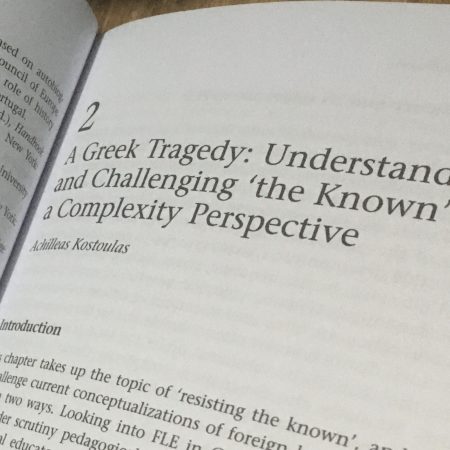
Eventually the chapter, along with the other submissions, made its way to the book reviewers, after a few edits which we collaboratively worked on with Damian. The most important of those changes was Damian’s suggestion to rename the chapter: he suggested A Greek Tragedy: Understanding and Challenging ‘The Known’ From A Complexity Perspective. My initial reaction was that this title was rather too colourful and too critical for my taste, but I was Damian’s arguments were persuasive. Incidentally, there is some good advice out there against choosing too clever titles. I was happy to ignore it in this instance, and several years later, I am still pleased with this decision.
When the reviewer’s report came back, I was obviously very happy to read that “Chapter 2 is an excellent chapter – academically rigorous and yet accessible and stimulating to the novice and the expert alike”. I was also happy to make two small changes at the reviewer’s request, both of which aligned with feedback I had got independently from my PhD supervisor. However, the reviewer had not been uniformly kind to all contributors, and some of his remarks suggested the need for very extensive changes to some chapters. This led to a significant delay for another, independent, review and for making all the necessary changes.
Copyediting & proofreading
The delay in the project would have been an great opportunity for me to look for language problems and improve my prose. However, in view of the positive feedback, I didn’t quite grasp the importance of this task, and focussed on what were at the time more important priorities. It was also my understanding that the press would assign proofreading to professionals employed by the press, so I didn’t worry too much about a task that matched neither my skills or interests.
This was a decision which I came to regret when I received the galley proofs of the chapter. Galley proofs are the finalised version of the paper, after it has proofreading and typesetting. Authors receive these documents to correct the odd typo that might have eluded the professional proofreaders’ hawk eyes. In my case, I was rather horrified to see that the proofreaders had missed several typos, as well as many redundant or missing words. To make matters worse, they had taken some ill-advised liberties with my punctuation. In all, I had to send a request for no fewer than 37 last-minute changes, which must have challenged everyone’s good will.
Finally…
As the book is now in bookshops, the question one asks oneself is: Was it worth it? For me this project was a great opportunity to showcase some of the work from my PhD, and test out some concepts that eventually made it into my dissertation. It was also a wonderful change to work with dedicated academics who helped me to develop. I certainly hope that, if you do happen to read the chapter, it will also be worth your time.
If you have landed on this page looking for information about getting your own work published, I hope that this narrative has been of some help. I’m happy to hear from you if you have additional questions, and I would love to read about your own publication experiences in the comments section. Please feel free to use the social sharing buttons at the bottom of this page to share this post with anyone who might find it interesting.

About me
Achilleas Kostoulas is an applied linguist and a language teacher educator at the University of Thessaly in Greece. He holds a PhD and an MA in Teaching English to Speakers of Other Languages from the University of Manchester (UK) and a BA in English Studies from the University of Athens.
Since writing this post, he has published several journal articles and a few monographs and edited collections (full list of publications) on topics relating to language teaching and learning. A lot of his work focuses on empowering language teachers to research and write about their practice. The edited volume Doctoral study and Getting Published: Narratives of Early Career Researchers (2025, with Richard Fay) is an example of such work.
About this post
I originally wrote this post on 25 November 2014, when the book Reisting the Known was about to hit the press. I revised the post, to improve formatting and structure on 7 October 2025.
The content of the post does not reflect the views of my employers, or those of the editor and publishers of the book. The featured image is my own work.


Leave a Reply