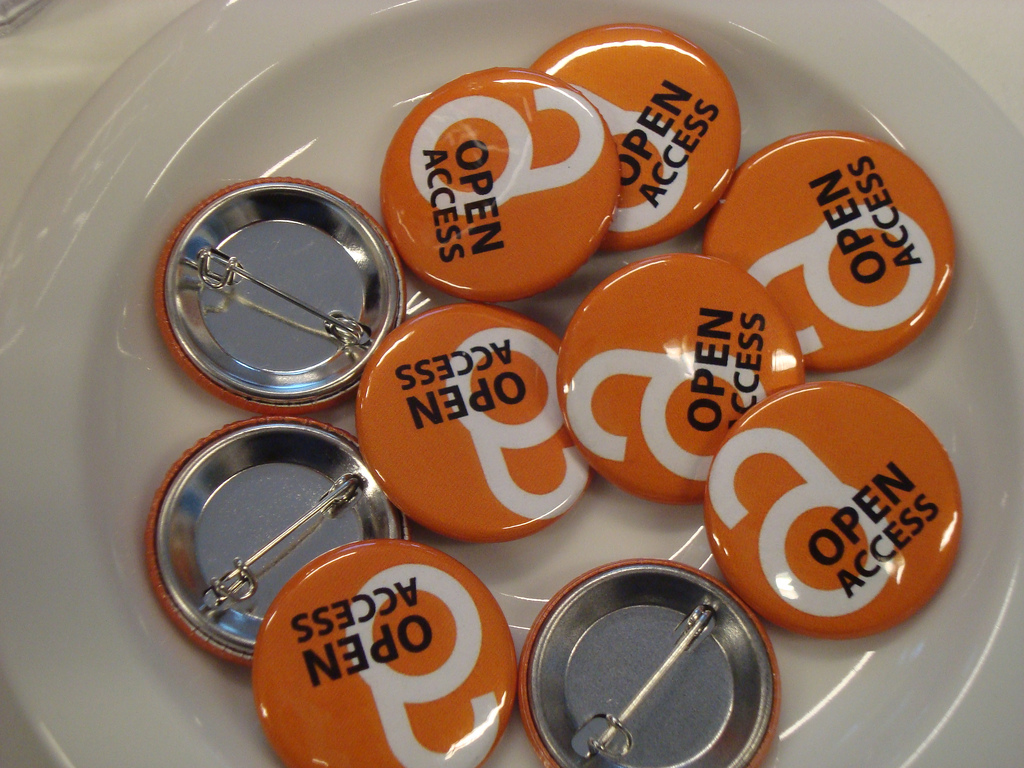
This blog post was prompted by Open Access Week 2013, which began on Monday (21st October) and will run until 27th October. What I aim to do in the paragraphs that follow is describe what the Open Access publication model involves, discuss some salient advantages and concerns, and provide readers with resources which I have found useful. It is by no means an exhaustive treatise on Open Access, but I hope that it can function as a primer for those among us for whom this is a new concept.
Note: Some information in this post, which was correct at the time of publication, particularly regarding article processing charges may no longer be current.
What is Open Access?
Simply put, Open Access (OA) publications are scholarly publications that readers can read free of charge. Most commonly, the term ‘OA publications’ refers to journal articles, although similar models are emerging for books as well. Under the OA publication model, publication costs are borne by the author(s) or by their sponsors. In this regard, OA differs from traditional publishing, where readers (or libraries) bear such costs. Open Access publications undergo peer review, just like any other publications. Ideally, the same standards of rigour are the same as with traditional publications (but more on that later). You can find more information about OA publishing in this briefing document.
Why consider Open Access?
From an author’s perspective, choosing an Open Access journal as an outlet for dissemination of their research will likely lead to increased visibility and impact. The OA publishing model is also beneficial to users who do not have institutional access to paywall-protected research. Even in the case of large, affluent universities, there are mounting concerns that the traditional model of publication, which relies on institutions purchasing subscriptions to journals, is no longer sustainable (update: this link to a memo from the Harvard library is sadly no longer available). You may want to read a detailed listing of benefits associated with the OA model, along with supporting references, by clicking here.
Several government agencies and other research funding bodies are gradually adopting Open Access policies. This means that researchers who receive funding from these agencies undertake to make the findings available to the public through OA publications. Such policies have been implemented (or are being phased in) by the US federal government (1, 2), funding agencies in the UK (1, 2, 3), and the European Commission, among others. By way of example, in the EU, research output produced with Horizon 2020 funding must be made accessible online no later than six months after initial publication (or 12 months for the social sciences and the humanities). There is an expectation that 60% of publicly-funded research in Europe will be available under Open Access by 2016.
What are the differences between ‘Green’ and ‘Gold’ Open Access?
In the Green Open Access model, the author can archive a post-print version of a published article in an institutional repository, a discipline-specific repository or the author’s personal website, all of which should be publicly accessible. Post-prints are papers that have undergone peer-review, and have satisfied publication requirements, but have not been typeset or formatted by the journal yet. Generally speaking, copyright remains with the journal, and not all journals allow this kind of archiving as a default option, but it is always possible to negotiate. Green OA might involve a fee, and/or there may be an ’embargo’ period, during which the paper is only available to journal subscribers. The SHERPA/RoMEO database lists the copyright policies for a large number of journals, and researchers who consider publishing under Green Open Access should consult it.
Under Gold Open Access, journals make published papers immediately available for viewing to anyone interested, free of charge. To cover costs, Gold OA often requires authors to pay substantial article processing fees (APCs) upfront. From April 2013 onwards, research funds have been made available in the UK to cover APCs. Regrettably, this publishing model has attracted many publishers of dubious repute, who do not engage in rigorous peer review, and whose output is far from scholarly. Beall’s List is currently the most comprehensive listing of predatory, or potentially predatory publishers, and researchers who consider publishing under Gold Open Access should consult it (update: this list is no longer online).
Are there any downsides to Open Access?
The Open Access publication model has come under sustained scrutiny, because the quality of OA journals is somewhat uneven. Most recently, Science reported on a ‘sting’ operation, in which different machine-generated versions of spoof paper appeared in no fewer than 157 OA journals. This was despite the fact that, in the author’s words, “[a]ny reviewer with more than a high-school knowledge of chemistry and the ability to understand a basic data plot should have spotted the paper’s short-comings immediately“, and the experiments reported were “so hopelessly flawed” as to render the paper devoid of meaning. The conclusions of the ‘sting’ operation were criticised by several OA proponents (examples: 1, 2, 3), however. In their responses, they pointed out that the affair demonstrated a failure of the peer-review process, rather than a problem inherent in the OA model. They also noted that traditional publishing has not proved immune to such disasters (e.g., the Sokal hoax, and other less famous cases: 1, 2). Nevertheless, it seems that the financial considerations involved in OA, particularly in the Gold model, are such that invite corruption in ways that traditional publishing doesn’t.
Discussions of the Open Access publication model are often framed in a discourse of academic ethics. In such debates, the argument is often put forward that OA democratises the research process by providing researchers in low-resources contexts with equal access to publications. However, a compelling case could also be made that, in some respects at least, this approach to publishing might widen the gap between privileged and less privileged academic settings. There can be little doubt that researchers without access to funding will benefit from being able to peruse scholarly publications under OA. What is less obvious is that, since publication costs are transferred to the author, such researchers are likely to find it harder to publish. This seems particularly true in the case of researchers in developing countries and in chronically underfunded disciplines, such as the Arts and Humanities. Even if funding agencies sponsor publication, it is difficult to see how the scope and quality of research will remain unaffected by higher publication costs. On the whole, it seems fair to say that eventually, in the majority of cases, Open Access will likely make it easier to consume research outputs, but harder to produce them. To the best of my knowledge, a discussion about how such risks might be avoided has yet to develop in earnest.
By subscribing to this blog, you will receive occasional updates on topics relating to language education, including my ongoing work on AI in language teaching and learning and on the research literacy of language teachers. (privacy policy)
You may also be interested in these posts

Fifteen years of Academic Blogging: Writing Slowly in Public
Written at the end of my fifteenth year of academic blogging, this post reflects on what it means to write slowly, publicly, and without a growth narrative. It considers the blog as a space for unfinished ideas, deferred reading, and forms of academic work that sit uneasily with faster, more performative platforms.


November 2025: Notes on Teaching, Research, and Writing
Tucked between October’s rush and December’s sparkle, November unfolds in steady academic labour.

Writing as Theorising for Language Education
This post explores theorising for practice in language education, showing how reflective and reflexive writing help teachers connect classroom experience with theory to develop situated, evidence-informed understandings (small-t theories) of their professional practice.

About me
Achilleas Kostoulas is an applied linguist and language teacher educator at the Department of Primary Education, University of Thessaly, Greece. He holds a PhD and an MA in Teaching English to Speakers of Other Languages from the University of Manchester, UK and a BA in English Studies from the National and Kapodistrian University of Athens, Greece.
His research explores a wide range of issues connected with language (teacher) education, including language contact and plurilingualism, linguistic identities and ideologies, language policy and didactics, often using a Complex Dynamic Systems Theory to tease out connections between them. Some of his work in the field includes the research monograph The Intentional Dynamics of TESOL (2021, De Gruyter; with Juup Stelma) and the edited volume Doctoral Study and Getting Published (2025, Emerald; with Richard Fay), as well as numerous other publications.
Achilleas currently contributes to several projects that bring together his long-standing interests in language education, teacher development, and the social dimensions of language learning. As the coordinator of the expert team of AI Lang (Artificial Intelligence in Language Education), an initiative of the European Centre for Modern Languages of the Council of Europe, he works on developing principles and resources to help educators make informed, pedagogically grounded use of AI in their teaching. He also leads the University of Thessaly team of ReaLiTea (Research Literacy of Teachers), a project that supports language teachers in developing the capacity to engage with, and contribute to, educational research. Alongside these, he contributes to LocalLing, a Horizon-funded initiative to preserve and strengthen heritage and minority languages globally.
In addition to the above, Achilleas is the (co)editor-in-chief of the newly established European Journal of Education and Language Review, and welcomes contributions that explore the dynamic intersections between language, education, and society.
About this post
This blog is a space for slow, reflective thinking about applied linguistics language education, professional development, and the role of technology in language teaching and learning. Transparency about process, tools, and authorship is part of that commitment.
- I wrote this post on 23 October 2013, as part of the ongoing discussion about the Open Access Week 2013. The post was revised on 11 February 2026, to refresh formatting.
- The views expressed here are personal and do not necessarily reflect those of the University of Thessaly or any other entity with which I am affiliated.


Leave a Reply