We are already halfway through March, and this marks the completion of the first stage of our LocalLing meeting in Volos. LocalLing, you might recall, is the short name for our Revitalisation of Linguistic Diversity and Cultural Heritage Horizon project, and over the last 15 days, the University of Thessaly has been hosting the month-long kickoff meeting. I have already posted a brief description of the activities of the first week (2nd-6th March 2026), and what follows is an overview of the second week of meetings, workshops and presentations that took place between 9 and 13 March. It has been an exciting and productive week, and if you’d like to find out more, join me as I talk about it.
A week of learning together
Research training
While Week 1 of the meeting focused more on networking and preparation, the second week was about research training and capacity building. This involved a series of workshops and presentations, jointly organised by Tallinn University and the University of Thessaly. Some of the highlights included:
- A workshop on writing grant proposals, facilitated by Xavier Dubois (Tallinn University). Even though I have some experience writing such proposals, including occasionally successful ones, I found out that I had much to learn, and I wish we had had more such experience in the formative years of my career.
- A workshop on Nexus Analysis, led by our (University of Thessaly) Sotiria Kalbeni. Nexus analysis is interdisciplinary framework for exploring multilingualism, heritage languages, and linguistic repertoires as socially embedded practices, which Sotiria has put to great use in order to understand and challenge language policies in corrective facilities. In the workshop, we explored how it might be deployed in the study of communities where local heritage languages are used.
- A presentation of good practices for supporting early-career researchers by Tanya Elena Fernandez Escudero (Tallinn). IN this slot, we discussed options such as doctoral networks and mobility options that can help junior researchers develop and become empowered.


Sharing research
A second strand of our work involved exchanging ideas about the ongoing research across our consortium. Iris Campos (University of Zaragoza) and Caroline Calvet (University of Montpellier) described their VulneRom project for the study of vulnerable languages in the Romance-speaking space. Nadia Bouchhioua (University of Manouba) talked about her ongoing research into the pronunciation of the Shiha Berber1 variety, which provides useful insights into language contact. Our colleagues from the University of Caldas in Colombia, Germana Carolina Soler Millán and Guillaime Roux, presented a rich portfolio of projects ranging from L2 acquisition to serious gaming deployed for teaching and learning heritage languages. And representing the Itqan foundation in Morocco, Professor Yamina El Kirat El Allame, Oumaima Elghazali and Yassine Boussagui talked about ongoing projects studying multilingual language policies and intergenerational transmission through folk tales.
A book presentation
One of the moments I enjoyed most in this week was the opportunity to present Language Politics in Tunisia, by Fethi Helal and Joe Lo Bianco.2 I plan to write more about the book in a different post, but briefly it reports on ten years of language ideological debates in Tunisia, from the Arab Spring onwards, where Tunisia struggles to define its identity among the competing ideologies of Arabisation, Francophonie, anglophone pragmatism and tunisian-ness. There are few books like this, in terms of the scope and analytical rigour, analytical insight and the ease with which philosophical depth is casually deployed.
The presentation took place in one of the most beautiful bookstores in Volos, Charta (Χάρτα), who generously sponsored the event by offering their space, and I was also delighted to see the unexpected attendance of several of my students. I have never pretended that making such events happen is easy or unstressful, but it is moments like this that make it all worthwhile.

Linguistic landscape walk
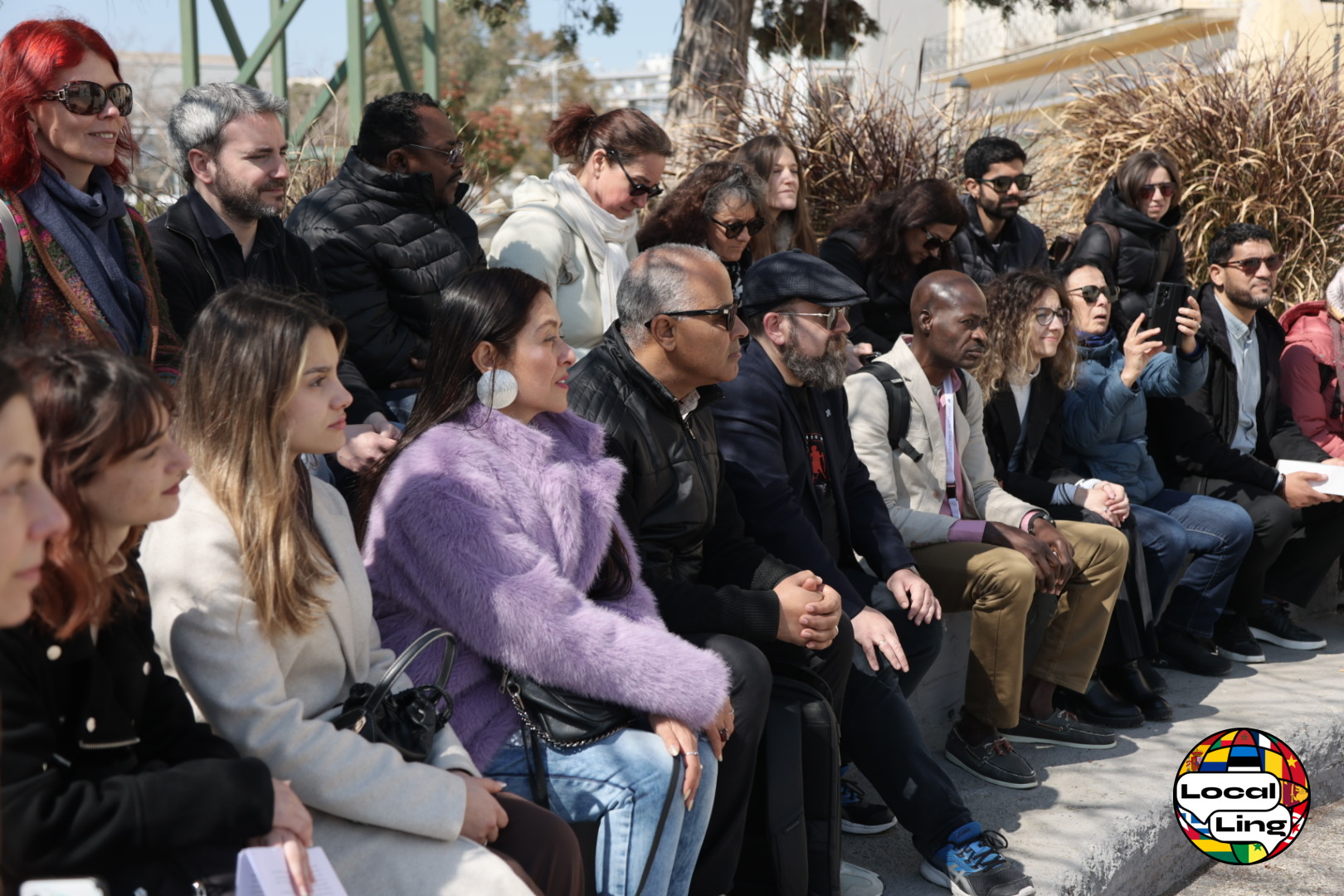
Another highlight of the week was the linguistic landscape walk around Volos, organised by Roula Kitsiou’s Volos Linguistic Landscape Research Group. We started that day (March 12th) with a brief introduction to linguistic landscapes research, presented by Roula and Maris Saagpaak (Tallinn University), and then we broke up into groups to walk around Volos, with Roula and her assistants pointing out the ideological work language does in public monuments, graffiti and spaces contested by authorities and grass-roots movements.3

Behind the scenes
While we were busy with the academic aspects of the conference, much of the genuinely challenging work was being done by the amazing support teams of Tallinn University and the University of Thessaly.
Team Tallin, who were with us on Week 1 of the LocalLing meeting, but are always present with us in spirit, kept the project communications running, and made sure we always had the documentation we required – a non-trivial task for a project that involves collaboration across several different countries, travel and visa requirements and ensuring compliance with the substantial EU red tape. Somehow, in the middle of all this, they also managed to put up our new website, which we are now populating with content. Eva and Elo, aitäh!
Team Thessaly
But I would mostly want to acknowledge my own team, a team of which I am genuinely proud.
Evangelia Theodoropoulou, our project operations lead, who anticipated needs and proactively dealt with problems, gently reminded me of what I needed to remember and patiently resolved situations when I forgot her reminders.4 Evangelia is the kind of colleague you never knew you needed before you met them, and after that you cannot imagine working without them.
Dimitra Giannouka, who –in addition to her unglamorous role as finance officer—also took on the photography and PR tasks, a job that proved much more demanding than I had originally planned.5 Dimitra is one of those rare individuals whose commitment to hard work, attention to detail, and creative talent make her simply irreplaceable.
Georgia Areti Karatzioli, the youngest member of our team, has been quietly but steadily ensuring that the many small logistical details that make an event like this possible are actually taken care of: coordinating materials, helping our guests navigate unfamiliar spaces, and stepping in wherever an extra pair of hands was needed. It is often the invisible work that determines whether a meeting runs smoothly or descends into chaos, and Georgia handled it with calm efficiency and good humour throughout the week.
Alexander, Danae, Thomas, and Sophia, thank you also for being there, always. Shortly before leaving us, Jan Blommaert, summarised his philosophy of what is important in academia in a few key words “to give, to educate, to inspire”. When you are around, it makes me think that I am on the right track.6


The coming weeks
Over the next two weeks, our work at LocalLing will continue, but it will change in format. Instead of working together as a single group, we will divide into smaller task forces or work individually on various subprojects. We are already looking forward to the presentation of the L1 acquisition laboratory on Monday, and two guest lectures by Fethi Helal, who will talk to our students about language and ideology. And there’s more to come, so stay tuned.
Footnotes
- With respect to my Imazighen friends, who reject the exonym ‘Berber’, I have retained the term our colleague selected. ↩︎
- Although I had, at times, engaged with Joe’s ideas, I had never met him before. He’s an amazing presenter, and a nice person overall. ↩︎
- One of most striking examples is the tug-of-war between the local authorities and some anarchist collectives about the name of a street, with both sides taking down the street signs and placing their own. ↩︎
- I am sorry for forgetting the adaptor. I know you told me several times… ↩︎
- And also meant that she became less visible in our outward-facing output… ↩︎
- The Doctor and Jackson Lake near the Tardis; the snow falls. ↩︎
By subscribing to this blog, you will receive occasional updates on topics relating to language education, including my ongoing work on AI in language teaching and learning and on the research literacy of language teachers. (privacy policy)

About me
Achilleas Kostoulas is an applied linguist and language teacher educator at the Department of Primary Education, University of Thessaly, Greece. He holds a PhD and an MA in Teaching English to Speakers of Other Languages from the University of Manchester, UK and a BA in English Studies from the National and Kapodistrian University of Athens, Greece.
His research explores a wide range of issues connected with language (teacher) education, including language contact and plurilingualism, linguistic identities and ideologies, language policy and didactics, often using a Complex Dynamic Systems Theory to tease out connections between them. Some of his work in the field includes the research monograph The Intentional Dynamics of TESOL (2021, De Gruyter; with Juup Stelma) and the edited volume Doctoral Study and Getting Published (2025, Emerald; with Richard Fay), as well as numerous other publications.
Achilleas currently contributes to several projects that bring together his long-standing interests in language education, teacher development, and the social dimensions of language learning. As the coordinator of the expert team of AI Lang (Artificial Intelligence in Language Education), an initiative of the European Centre for Modern Languages of the Council of Europe, he works on developing principles and resources to help educators make informed, pedagogically grounded use of AI in their teaching. He also leads the University of Thessaly team of ReaLiTea (Research Literacy of Teachers), a project that supports language teachers in developing the capacity to engage with, and contribute to, educational research. Alongside these, he contributes to LocalLing, a Horizon-funded initiative to preserve and strengthen heritage and minority languages globally.
In addition to the above, Achilleas is the (co)editor-in-chief of the newly established European Journal of Education and Language Review, and welcomes contributions that explore the dynamic intersections between language, education, and society.
About this post
This blog is a space for slow, reflective thinking about applied linguistics, language education, professional development, and the role of technology in language teaching and learning. Transparency about process, tools, and authorship is part of that commitment.
- I wrote this post on 14th March 2026, and it is my 400th post in about 15 years. I will periodically revise it to ensure accuracy, so feel free to point out any issues that come to your attention.
- When writing this post, I used artificial intelligence to support copy-editing and Search Engine Optimisation. I wrote the text, and retain responsibility for analytical thinking, authorial decisions and wording.
- The views expressed here are personal and do not necessarily reflect those of the University of Thessaly or the LocalLing consortium as a whole.
- The featured image is by Dimitra Giannouka. Other photos are hers, mine, and by other members of the consortium team. They appear here in a CC BY-ND-NC lisence: this means that you can distribute them by acknowledging hte LocalLing project as creator, but you may not change or monetise them.
- The link to Fethi’s book is an affiliate link. If you choose to buy the book (or any other) from Amazon after visiting this link, Amazon will pay me a small commission (currently about 4.5%), at no additional cost to you. Amazon will, of course, know you came from here (which you may or may not find comforting). The commission helps support this blog: a small transfer from a billionaire’s pocket to the costs of keeping this space going. Alternatively, and always encouraged, please consider supporting an independent bookstore.

Leave a Reply