
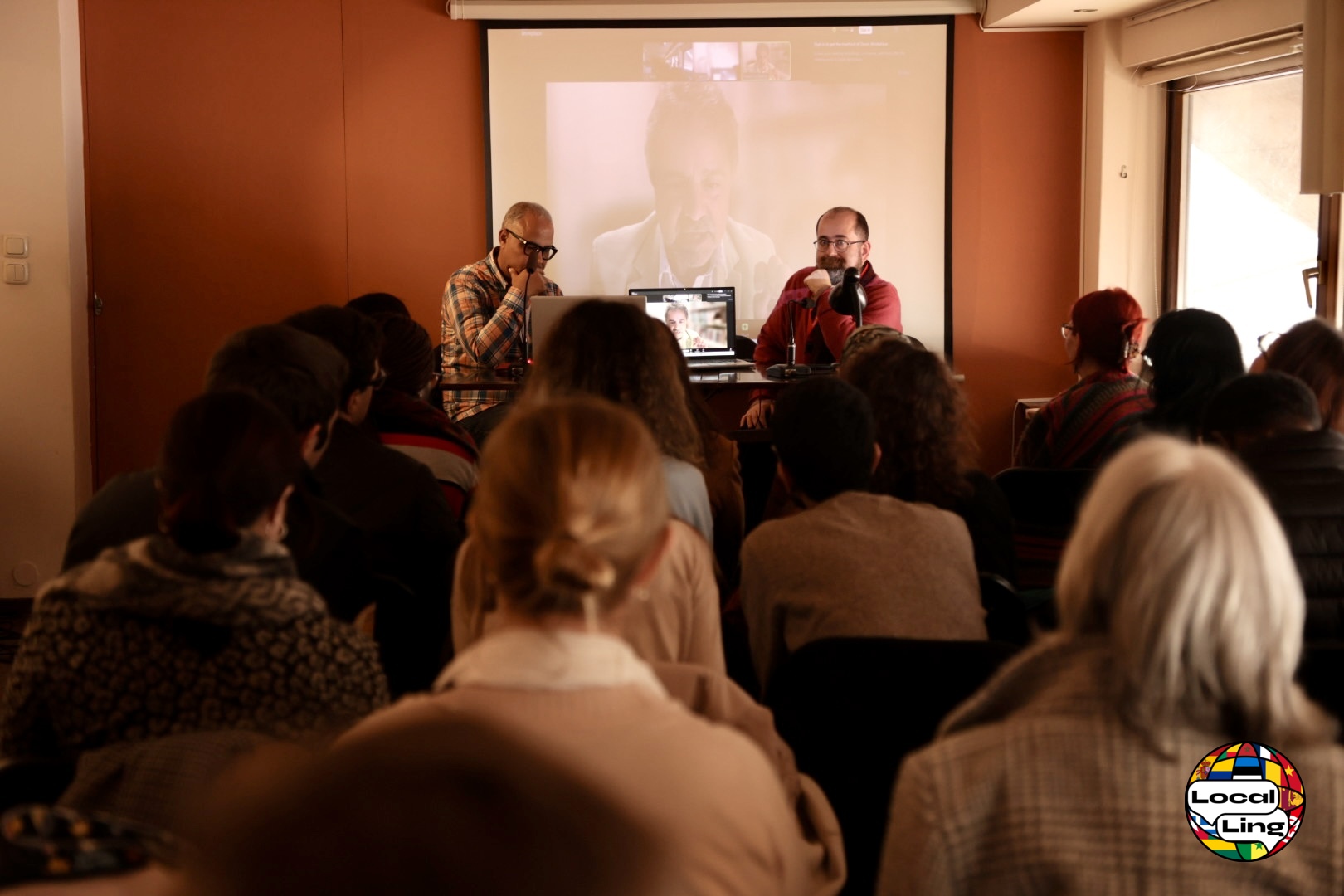
As we gradually make our way towards the last week of the month-long LocalLing meeting in Volos, I would like to pause and say a few words about one event that stood out for me: the day I presented a new, I believe important, book, Language Politics in Tunisia, by Fethi Helal and Joe Lo Bianco. If you have an interest in how language, power, and history intersect, and how these intersections are lived rather than merely legislated, you may find it worth reading on.
Language Politics in Tunisia: A Study of Language Ideological Debates
Like many countries in North Africa, Tunisia constitutes a rich linguistic ecology, where Arabic, French, English and Amazigh varieties intersect. Arabic itself spans Classical, Modern Standard, and a range of vernacular varieties, and connects Tunisia both to regional networks and to Islamic traditions. French, shaped by colonial history, continues to carry significant symbolic and institutional capital, particularly among elites. More recently, neoliberal pressures have introduced a growing Anglophone orientation. Alongside these, Amazigh varieties, especially in regions such as Djerba and Matmata, add further layers to this already complex repertoire.
The question that Language Politics in Tunisia poses is, exactly how do Tunisians navigate all this complexity, and in what ways has their identity emerged in the years following the Arab Spring? To answer this question, they painstakingly analysed an impressive corpus of data spanning 10 years of debates. Using a Discourse Historical Approach, a method of analysis informed by the writints of Ruth Wodak, Helal and Lo Bianco juxtapose four different language ideological positions (Arabisation, Francophonie, anglophone pragmatism, and a nationalist trend associated with the Tunisian vernacular. They conclude with a proposal for what they term the Tunisian Language Compact, a negotiation-based solution that seeks to synthesise the contradictory discourses outlined above.
What makes the book stand out
But why should a Greece-based linguist, and an international audience of readers, be interested in the linguistic ecology of Tunisia? While modestly framed as a discussion of a single country, Helal and Lo Bianco’s book is about identity, language and power, and about the ways in which these interconnect. The Greek linguistic ecology is very different, and yet, as I was reading, I found striking parallels in how languages acquire value, circulate, and index social positioning. I also found the way that the book balances between empirical description and theoretical discussion, effortlessly invoking philosophical concepts such as Wittgenstein’s language games, very impressive. This was a book that was a genuine pleasure to read.

The book presentation
The idea for the book presentation came from Fethi Helal, one of our LocalLing guests, shortly before the meeting started. At the time, I was struggling with logistical preparations, and I would probably have delegated it to someone. But Fethi had also included a copy of the book in his invitation, and it proved much more interesting than writing conference-related emails… By the time I read the first three chapters, where Helal and Lo Bianco describe their theoretical background, I had made up my mind to do the presentation myself.
Making miracles happen
in the last minute
The presentation took place in Charta, arguably the nicest bookstore in Volos. This was entirely unplanned: I was walking with our guests from the Faculty of Humanities to the University Library, when we passed outside the store, and I had an epiphany. I turned to Dimitra, our PR manager, and asked if relocating the presentation there rather than in the Humanities1 building would be insurmountable logistically. Her answer was the widest smile she gave in the entire meeting – so, on the next day, I was at the bookstore with our operations officer, Evangelia, asking them what it would cost to use the space. They were happy to give it to us for free, for which we are most grateful.
Of course, relocating an event at the last moment was not quite straightforward. Posters had to be re-printed, projectors had to be moved, laptops and conference microphones had to be transported, and we needed to find a way to beam Joe Lo Bianco via Zoom, into a room that was not designed for online meetings. Evangelia is a miracle worker when it comes to things like this, and I knew that I could trust her with everything, so that I could focus on just three tasks: prepare my presentation, bring the participants to the bookshop in time, and bring along a cable adaptor.

Presenting the book
On the actual day of the presentation, when the LocalLing group met at the Faculty of Humanities, several of my students approached me. I thought they wanted to ask me if we’d have a lesson that day, and I was mentally preparing to remind them to read their email; but to my surprise, they wanted to know if they could attend the presentation, since they had no class. Students… they never cease to delight you.2
So, off we went to the bookstore. Leading academics to any place is very much like herding cats, and car drivers in Volos are not pedestrian-aware, so I felt some relief when I arrived in Charta with all my guests accounted for.3 And of course I had forgotten the adaptor…
Still, we did manage to set our equipment up and start on time, and I sighed another sigh of relief when the audio worked and we managed to hear Joe Lo Bianco’s voice. I had read his work on language policy in the past, but I had never met him; he’s a brilliant speaker, and I think he captivated the audience. I also really enjoyed Fethi’s presentation: What struck me, listening to him, was not just the clarity with which he laid out the Tunisian case, but the way he resisted simplifying it. It would have been easy to frame Tunisia in terms of familiar binaries (e.g., Arabic vs. French, policy vs. practice, identity vs. utility…) but what emerged instead was a far more layered account of how linguistic resources are mobilised, valued, and contested in everyday life.


And was it worth it, doctor?
As I sat in the room, my own modest remarks completed, I caught myself looking at the audience and thinking that in many ways, this small event captured something central to the LocalLing project. We often speak about linguistic ecologies in abstract terms, but here we were, inhabiting one: multiple languages, multiple trajectories, and multiple ways of understanding what language does in society, all brought into temporary alignment through a shared act of attention. And that is how you know that something worthwhile has happened.
By subscribing to this blog, you will receive occasional updates on topics relating to language education, including my ongoing work on AI in language teaching and learning and on the research literacy of language teachers. (privacy policy)
Footnotes
- Arguably the darkest, dirtiest and ugliest building in the University of Thessaly. ↩︎
- Don’t get me wrong; they are infuriating in equal measure. But it’s moments like these that make it all worth the while ↩︎
- Including the one who stopped to buy a pataounga. *angry emoji* ↩︎

Call for proposals: CCERBAL 2027, Bilingualism and Multilingualism at the Intersections of Art, Science, and Technology
I will be delivering a keynote address at the CCERBAL 2027 conference, this is the call for papers, and I’d love to see you there, in person or virtually.


Wrapping up the ReaLiTea project
The Research Literacy of Teachers (ReaLiTea) project ends in December 2026. Here’s a sneak peak of the materials we’ve been producing. Feel free to look around, and let us know how we can make them more useful and relevant to your needs.

September 2026: Notes on Care (Besorgen and Fürsorge)
Notes on September 2026: a finished chapter and a finished manuscript, an AI Literacy meeting in Graz, ReaLiTea’s final stretch, LocalLing visits from Cameroon to Tallinn, and a sabbatical that keeps filling up with travel.

About me
Achilleas Kostoulas is an applied linguist and language teacher educator at the Department of Primary Education, University of Thessaly, Greece. He holds a PhD and an MA in Teaching English to Speakers of Other Languages from the University of Manchester, UK and a BA in English Studies from the National and Kapodistrian University of Athens, Greece.
His research explores a wide range of issues connected with language (teacher) education, including language contact and plurilingualism, linguistic identities and ideologies, language policy and didactics, often using a Complex Dynamic Systems Theory to tease out connections between them. Some of his work in the field includes the research monograph The Intentional Dynamics of TESOL (2021, De Gruyter; with Juup Stelma) and the edited volume Doctoral Study and Getting Published (2025, Emerald; with Richard Fay), as well as numerous other publications.
Achilleas currently contributes to several projects that bring together his long-standing interests in language education, teacher development, and the social dimensions of language learning. As the coordinator of the expert team of AI Lang (Artificial Intelligence in Language Education), an initiative of the European Centre for Modern Languages of the Council of Europe, he works on developing principles and resources to help educators make informed, pedagogically grounded use of AI in their teaching. He also leads the University of Thessaly team of ReaLiTea (Research Literacy of Teachers), a project that supports language teachers in developing the capacity to engage with, and contribute to, educational research. Alongside these, he contributes to LocalLing, a Horizon-funded initiative to preserve and strengthen heritage and minority languages globally.
In addition to the above, Achilleas is the (co)editor-in-chief of the newly established European Journal of Education and Language Review, and welcomes contributions that explore the dynamic intersections between language, education, and society.
About this post
This blog is a space for slow, reflective thinking about applied linguistics language education, professional development, and the role of technology in language teaching and learning. Transparency about process, tools, and authorship is part of that commitment.
- I wrote this post on 22 March 2026. I will periodically revise it to ensure accuracy, so feel free to point out any issues that come to your attention.
- The views expressed here are personal and do not necessarily reflect those of the University of Thessaly or the LocalLing consortium.
- The photography in this post is by Dimitra Giannouka for the LocalLing project (if branded) and other LocalLing participants. This is shared with an Attribution, Non-Commercial, No Derivatives [CC BY-NC-ND] lisence. This means that you are free to reuse and distribute the photos, as long as you provide proper credit. However, you cannot modify the photos in any way (including removing the logo) or use them in products or services for which you charge fees.
- The link to the book is an affiliate link. If you choose to buy any book from Amazon after visiting this link, Amazon will pay me a small commission (currently about 4.5%), at no additional cost to you. Amazon will, of course, know you came from here (which you may or may not find comforting). The commission helps support this blog: a small transfer from a billionaire’s pocket to the costs of keeping this space going. Alternatively, and always encouraged, please consider supporting an independent bookstore.

Leave a Reply