
April, I have found, is a month that tends to promise more than it delivers. It arrives with an air of possibility: longer, brighter days, a semester that has gathered enough pace to allow for productive and enjoyable things to happen, a conference season that’s starting, and you can be forgiven for thinking that things might still fall into place. And yet, April often turns out to be a month of sustained effort, of work that happens in the margins between teaching and meetings and travel, and of fatigue that only becomes visible when you pause, at the end of the month, to take stock.
This post is that pause. In it, I try to make sense of a month that was both intellectually stimulating and personally demanding, raising questions I haven’t fully resolved, and occasionally raising some work of noble note.1 If that sounds like the kind of academic life you recognise, or are curious about, perhaps you’d like to read along.
Scholarship
The Easter break has meant that many chapters of the Empowering Language Teachers through Research Literacy volume (Ringel, Dilkilitaş & Kostoulas, eds., in preparation) have finally found their way into my inbox. This is good, not just because it moves us a step closer to publication, but also because I genuinely enjoy engaging with scholarship in manuscript form. Compared to reading the finished article, I find the process more dialogic and productive. Hopefully, so do the authors.
At different stages of preparation, another book project –this one on global linguistic ecologies– is waiting for chapters, a proposal for a new book is at an acquisition editor’s desk, and a new idea is under discussion with a brilliant coauthor. You’d think I’d know better than to get myself involved in such projects, but the truth is that I find both the process and the final product very rewarding.
Almost invariably, that is.
Language coursebooks
This month also saw the publication of the Modern Greek Language Textbooks that I coordinated for the Ministry of Education and the University of Athens. I have written about this experience elsewhere, so I needn’t repeat myself here. The book is out there now, it has my name on it, and my feelings about that are not straightforward. I’ll leave it there.
Motivation article
On a somewhat more pleasant note, I was happy to see an article published from a thesis by my former student, Konstantina Rizou. Konstantina, one of the participants in the MA in Language Education for Refugees and Migrants, was keen on understanding how teachers perceive and describe the motivation of learners with refugee and migrant backgrounds. There are lots of studies out there on student motivation, but whatever a student’s actual motivational state, it’s the teacher’s perception of that motivation that shapes how they respond (e.g., by offering more challenging tasks or more encouragement, or simply by lowering expectations). A misread student can end up in a self-fulfilling cycle.
One thing that I found impressive when working with Konstantina was that she was never shy of challenging existing frameworks on motivation (e.g., Self-determination theory, investment theory and the L2 Motivation Self System) and pointing out their limitations. Although her study drew loosely on my own work on Intentional Dynamics (Stelma & Kostoulas, 2021)2, Konstantina felt comfortable re-arranging the building blocks of our theoretical model until they made sense to her, which resulted in an unusually original synthesis. You can read more about that (and download the article) in a more detailed post I wrote earlier this month.
Research updates
While writing and editing kept me productively and happily occupied throughout much of April, work on my research projects has been continuing and increasing in visibility.
LocalLing
The kick-off phase of the Revitalisation of Linguistic Diversity and Cultural Heritage project (LocalLing), which I organised in Volos, is now behind us. Its success, I think, lies in the momentum it has produced for continuing work on language revitalisation. This is evident in the increased international mobility and exchanges in events that focus on minoritised languages.
Within weeks, our Moroccan partners organised the 1st International Conference on the Amazigh language at Ibn Zohr University, which is —I believe— a significant institutional moment for a language that has long struggled for recognition in formal academic spaces. In the Pyrenees, team members Iris Orosia Campos Bandrés (Universidad de Zaragoza) and Caroline Calvet (Université de Montpellier Paul-Valéry) took their collaboration to Sabiñánigo, a town whose linguistic heritage makes it a very apt place to talk about reclaiming minoritised languages. And somewhere in between all of this, I found myself drawn into planning something I hadn’t anticipated: an event centred on diasporic Greek.3 More on that when there’s more to say.
What strikes me is how different these three threads are in terms of location, languages and institutions, and yet how they all pull in the same direction. Language revitalisation work tends to breed more of itself when conditions are right. LocalLing, it seems, may be helping with these conditions.

AI Lang
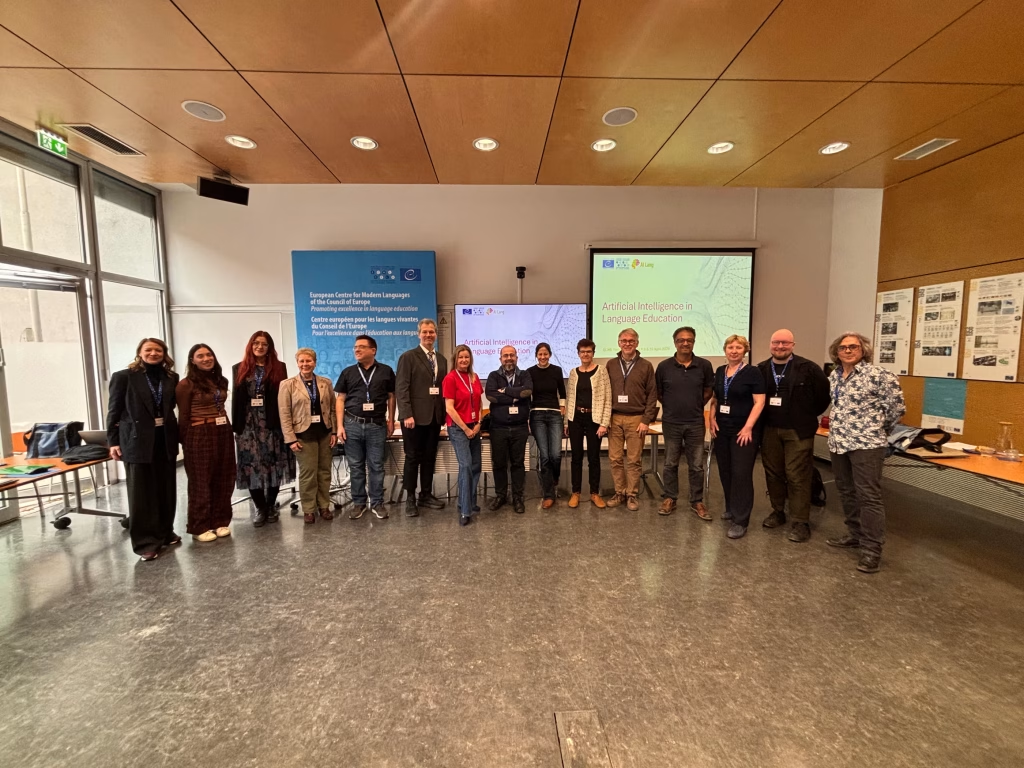
A highlight of April was the network meeting we organised in Graz on the 9th and 10th of April, for the Artificial Intelligence for Language Education (AI Lang) project.
In the meeting, we invited experts from across Europe to critically discuss our framework of principles for the ethical use of AI, and we also exchanged examples of good practice. We are looking forward to showcasing some of the latter in our Moodle professional development course.
This is, perhaps, not the best moment to go into too much detail about the thinking that this meeting prompted, but one thing that has stuck with me was the following remark: “We say there is value and strength in diversity; why should we then feel frustrated when views on a project do not align?”

ReaLiTea
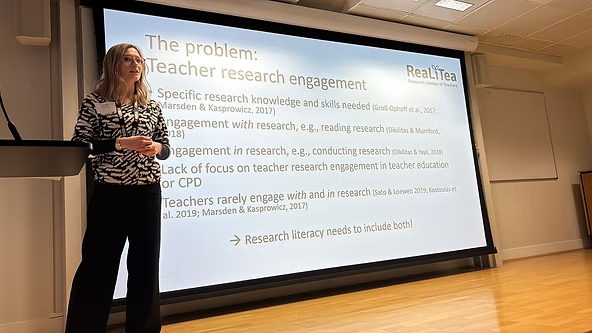
As we move towards the completion of the Research Literacy of Teachers project, I am conscious of a certain feeling of satisfaction felt when things fall neatly into place. Indeed, in our semi-annual coordination meeting, which took place on 20th April 2026, we confirmed that most of the outputs were either complete or nearing completion, and that what remained was mostly fine-tuning.
It was also satisfying to see that our work has been receiving very positive feedback at our dissemination events. On 25th April, the teacher research literacy framework was presented in the inaugural BERA Teacher Network Conference entitled Research Making a Difference in the Classroom (Birkbeck College, University of London). At the same time, we have been liaising with the Ministry of Education in Cyprus, who are keen on adapting our materials for the professional development of their teachers.
So, it looks like we will have a lot to discuss next month, when the ReaLiTea team meets again at the University of Bergen. That is something to look forward to.
Other seminars and talks
AI, language teaching & translation
On 23rd April 2026, I found myself talking among a panel of experts at the Artificial Intelligence in English Language Teaching and Translation: Bridging Research and Practice meeting organised by Francesca Raffi, at the University of Macerata. I have blogged on this in some detail (see link below), but what I would like to reiterate is the point about diversity. I had felt mildly apprehensive about what seemed to me as an unfocused discussion, spanning translation and teaching. After the event, I felt that the input from people whose expertise only partially overlapped with mine left me much richer.
AI-assisted research
in language education
Finally, on 30 April 2026, I had the chance to work with students at the University of Manchester,4 with whom we discussed how to best use artificial intelligence for research purposes. A question that many students kept returning to was whether there are ways to minimise bias in such research. I am not convinced that this is possible, at least not in qualitative research, whether one uses AI or not – after all, the LLMs are not the only source of bias: some comes from the ways we formulate our research questions, some comes from our participant selection, some comes from our pre-existing knowledge, and (in AI-assisted research) some will come from the tools we use.
The answer, I think, or at least the beginnings of an answer, lies in being reflexive about our work. This means constantly asking ourselves “what difference has it made to this study that it was me, rather than anyone else, doing this research?”, and —more to the point for this discussion— “what difference is it making to this study that I have used AI, as opposed to pen and paper, to produce this finding?” In some ways, the use of technology in AI-assisted research seems to hold up a mirror which forces us to take a more critical look at how we produce knowledge. Perhaps this is a strength, and maybe it is one we should lean into more deliberately.


Readings
One book I was particularly happy to receive this month was Heritage Literacy in the Lives of Chinese Muslims, by Ibrar Bhatt and Heng Wang. As a linguist, I have tended to approach cultural diversity from the perspective of language, so this book has usefully challenged my thinking by focusing on a group of people who do not have a shared language to encode and preserve their cultural practices. Heritage literacy, then, is a broad concept that encompasses art, religion, history and everyday practices; and what Bhatt and Wang have done is provide a rich ethnographic description that synthesises personal narratives from across China. For me, this feeds very usefully into our own work with the LocalLing project; more broadly, it’s a model of ethnography at its best.
Calls for papers
A periodic reminder: the European Journal of Education and Language Review, which I co-edit, is open for submissions. We’re interested in work that takes language seriously as social action: research that unsettles assumptions, engages with minority and lesser-resourced languages, and isn’t afraid of ideological or political questions. If that describes what you’re working on, I’d like to hear from you.
Behind the scenes
Writing these posts is, partly, a way of reminding myself of the things that matter in my work. And sometimes, such reminders are useful, because the answers to “why do I keep doing this to myself” are not always obvious, at least when set against the more visible toll on my wellbeing and health.
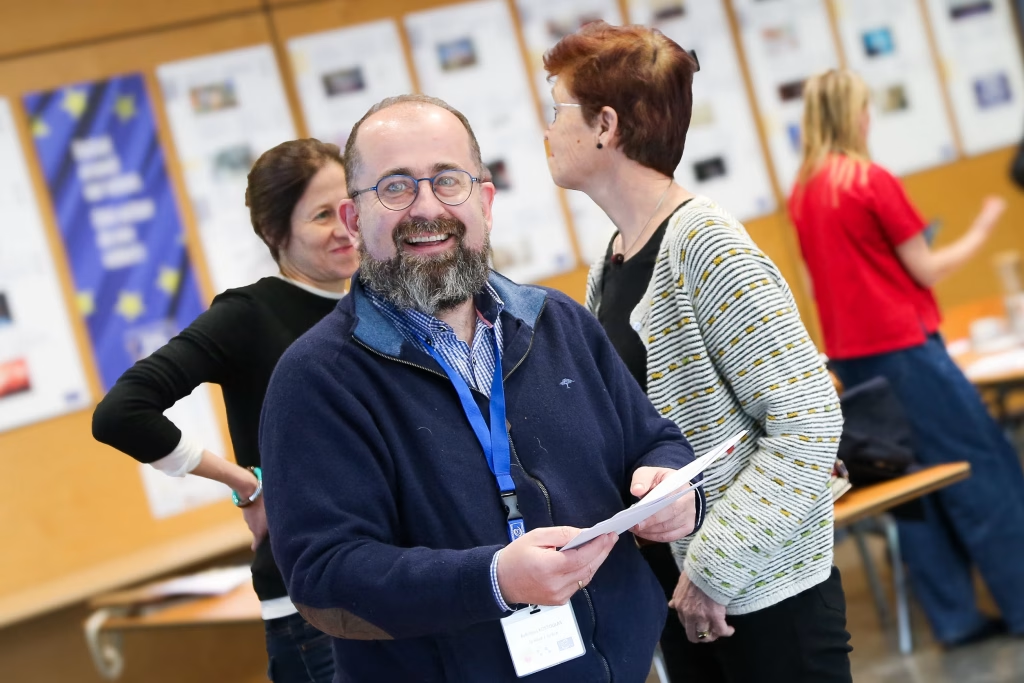
At some point this month, I found myself catching the sun in the Franziskanerplatz, leaning backwards and putting an espresso5 cup down on a metal table, with a very precise clink – and in that particular moment, I thought that no force in the universe could make me go back to the session I was supposed to lead. Commitment and force of habit eventually prevailed, as they do.
I was told later by someone who has often seen me present that the session was one of the best I’ve ever led. And somehow, our very talented photographer managed to take this photo of me. Someone later told me that they had never seen me smile like that. I don’t know how that happened, and to be honest, my recollection of the event is not one of particular enthusiasm.
What I do know is that the work keeps putting me in rooms I wouldn’t otherwise enter, with people I wouldn’t otherwise meet. That’s not nothing.
Looking ahead
I think this is the first time in a long series of posts where I do not have a concrete event to describe in the immediate future. Perhaps I can finally get some rest.
By subscribing to this blog, you will receive occasional updates on topics relating to language education, including my ongoing work on AI in language teaching and learning and on the research literacy of language teachers. (privacy policy)
Footnotes
- My AI assistant suggests removing this because it’s an “odd phrase”. That’s what happens when an LLM is trained on Wikipedia articles rather than the classical canon. ↩︎
- Stelma, J. & Kostoulas, A. (2021). The intentional dynamics of TESOL. De Gruyter. ↩︎
- Beyond Greece, Greek is spoken in Albania, Southern Italy, Cyprus and Turkey, as well as by second- and third-generation migrants in the Americas and Australia. The status of many varieties, i.e., whether they are dialects of Modern Greek or distinct languages, is of course an ideological question. ↩︎
- Special thanks to Paul V. Smith and Susan Dawson for inviting me to their Developing Researcher Competence course. Manchester, and the DRC, have a special place in my heart. ↩︎
- Yes, I know I shouldn’t be drinking coffee. Let’s keep this between ourselves. ↩︎

August 2026: Notes on Naming and Making Things Visible
A reflective look back at August 2026: publications finally appearing, research projects taking shape, books read, journal work, and the less orderly reality behind a seemingly productive academic month.


July 2026: Notes on Becoming, and Other Unfinished Business
Four book projects, two field trips, and a lot of unfinished business. Notes on teaching, research, and writing in July 2026.

March 2026: Notes on academic collaboration, strain, and scholarly direction
March 2026 was a month dominated by the kick-off meeting of the LocalLing project, perhaps the most important thing I’ve done in my academic life. This is how it unfolded.

About me
Achilleas Kostoulas is an applied linguist and language teacher educator at the Department of Primary Education, University of Thessaly, Greece. He holds a PhD and an MA in Teaching English to Speakers of Other Languages from the University of Manchester, UK and a BA in English Studies from the National and Kapodistrian University of Athens, Greece.
His research explores a wide range of issues connected with language (teacher) education, including language contact and plurilingualism, linguistic identities and ideologies, language policy and didactics, often using a Complex Dynamic Systems Theory to tease out connections between them. Some of his work includes the research monograph The Intentional Dynamics of TESOL (2021, De Gruyter; with Juup Stelma) and the edited volume Doctoral Study and Getting Published (2025, Emerald; with Richard Fay), as well as numerous other publications.
Achilleas currently contributes to several projects that bring together his long-standing interests in language education, teacher development, and the social dimensions of language learning. As the coordinator of the expert team of AI Lang (Artificial Intelligence in Language Education), an initiative of the European Centre for Modern Languages of the Council of Europe, is active in developing principles and resources to help educators make informed, pedagogically grounded use of AI in their teaching. He also leads the University of Thessaly team of ReaLiTea (Research Literacy of Teachers), a project that supports language teachers to engage with, and contribute to, educational research. Alongside these, he contributes to LocalLing (Revitalisation of Linguistic Diversity and Cultural Heritage), a Horizon-funded initiative for the preservation of heritage and minority languages globally.
In addition to the above, Achilleas is the (co)editor-in-chief of the European Journal of Education and Language Review, and welcomes contributions that explore the dynamic intersections between language, education, and society.
About this post
This blog is a space for slow, reflective thinking about applied linguistics, language education, professional development, and the role of technology in language teaching and learning. Transparency about process, tools, and authorship is part of that commitment.
- I wrote this post on 30th April 2026. I will periodically revise it to ensure accuracy, so feel free to point out any issues that come to your attention.
- When writing this post, I used artificial intelligence to support copy-editing and Search Engine Optimisation. I wrote the text, and retain responsibility for analytical thinking, authorial decisions and wording.
- The views expressed here are personal and do not necessarily reflect those of the University of Thessaly or any other entity with which I am affiliated.
- Some links in this post are affiliate links. If you choose to buy a book from Amazon after visiting one of these links, Amazon will pay me a small commission (currently about 4.5%), at no additional cost to you. Amazon will, of course, know you came from here (which you may or may not find comforting). The commission helps support this blog: a small transfer from a billionaire’s pocket to the costs of keeping this space going. Alternatively, and always encouraged, please consider supporting an independent bookstore.
- The featured image is by Azahara MarcosDeLeon, licensed from Adobe Stock.

Leave a Reply