This should have been a week of celebration. The Modern Greek language textbook that I helped to produce for the Ministry of Education have finally been approved, and they are now available for teachers across Greece. I have not talked much about this project, partly because some aspects were bound by non-disclosure agreements during the three-year production process, and partly because my own feelings about the project are complicated. I still don’t want to write much about the latter, except to go on record to say that this is not the book I had wanted to write. But just like a parent who still loves their children even when they are disappointed by them,1 I would like to talk about them.
Overview of the book
The series, Νεοελληνική Γλώσσα Γ’ Γυμνασίου, Επιλέγω και Επικοινωνώ2 [3rd Form Modern Greek: Selecting and Communicating], is part of a larger project comprising nine sets of books, starting from Primary Year 1 and culminating in the books we wrote. In the secondary level, there is a progression from revising structural aspects of language (in the 1st Form), focusing on communication in the 2nd Form, and finally moving on to a stronger critical literacy focus at the end of Junior High School.3

Also, unlike the preceding levels, which focused on descriptive, narrative and procedural texts, our coursebooks had a strong emphasis on persuasive and argumentative discourse. This was intentional: we believe that by the end of Junior High School, students are emerging citizens. They form opinions shaped by the discourses around them, and they deserve to be heard. We wanted to empower them to speak out by making purposeful use of language.
The series consists of three books: a main 200-page coursebook, accompanied by two 100-page workbooks focusing on grammar and language production. The two workbooks also contain an extensive appendix with a more theoretical description of language, which we mainly intended as a resource for teachers. We also produced a few hundred digital learning objects, such as online texts, exercises, interactive resources and so on, which students can access by clicking on the online versions of the books or by scanning QR codes in the hard copies.
Contents of the book
The book, and the workbooks that mirror it, consist of eight units, which roughly correspond to the structure of the school year in Greece, from mid-September to mid-June. Table 1 below shows the focus of each unit:
| Unit | Topic |
|---|---|
| Unit 1 | Prosperity: Economy and Wellbeing |
| Unit 2 | Connections: International Collaboration |
| Unit 3 | Democracy: Rights and Responsibilities |
| Unit 4 | Digital Life: Opportunities and Risks |
| Unit 5 | Ethics: Values and Choices |
| Unit 6 | Agency: Social Action |
| Unit 7 | Youth: Challenges and Opportunities |
| Unit 8 | Revision: Looking Back, Moving Forward |
The choices of topics, you might notice, are not uncontroversial. We did this deliberately, for two reasons. One connects narrowly to language education: You cannot teach argumentative and persuasive language using ‘safe’ topics with which students will not connect – topics like ‘the benefits of reading’ or ‘the importance of recycling’. Such themes might tick curricular boxes, but they are unlikely to spark the kind of genuine disagreement that drives sustained and meaningful communication, or by extension, language learning. We decided to include topics that generate strong feelings, topics about which students will want to talk, write and argue.4
You cannot teach argumentative and persuasive language using ‘safe’ topics
The other reason is broader: I believe that education has a responsibility to prepare young people for the world as it actually is, not a sanitised version of it. Democracy, digital surveillance at schools, and reproductive health, to name a few, are not abstract concepts. They are the terrain young people are already navigating, often without adequate tools. If the classroom cannot be a space where teachers and learners can examine these topics carefully and honestly, then it is hard to see where that space might be.
How we structured the units
Traditionally, language textbooks tend to begin with a text, which students and teachers process for meaning and then move on to formal language work. We decided to invert this format.
Free extensive reading
We believe that for students to be able to say anything, they need a range of resources: ideas, words and structures. This is why we begin each unit by asking students to read widely. We provide some texts in the textbook, as many as the page constraints would allow; more in digital form; and we encourage students to read even more widely. The idea is not to have students do the intensive kind of reading you often see in classrooms, where students might take turns and teachers mediate challenging passages. We want students to read texts of their choice, and bring ideas to the class that the class can discuss together.
I like to imagine situations where every student has read at least something – matching their strengths and interests, this might be an article or a comic book — about the unit’s topic and then they all brainstorm the topic together.
Learning about language
Following that, there is the kind of language work you’d expect to find in any such book. The second section of each unit consists of activities focusing on developing lexical range and accuracy, theory and examples illustrating how text is organised and so on.
Our organising principle here has been functional, again departing from traditional descriptions of Greek. Rather than focus on all the types of subordinate clauses in turn, for instance, we talk about different ways to express causality or temporal relations – whether by a subordinate clause, a word, a phrase and so on. And we compare what each way of expressing the same idea gives you and what it hides: ‘I’ll see you after dinner’ is not exactly the same as ‘I’ll see you after I’ve eaten’ or ‘after you’ve eaten’, and sometimes this matters. The idea is that students can use these options as toolkits or banks of resources, from which they deliberately select what seems most appropriate for their communicative purpose.

Listening, reading, writing,
and talking (back)
Next, we have communicative activities,5 organised in a typical tri-partite format, e.g., pre-reading, during-reading and post-reading phases.
A large part of the activities, however, especially in the receptive skills, focuses on critical understanding rather than surface recognition. For example, when presenting an interview by a linguist speaking about the role of Cypriot Greek in education, we students note when he shifts from first person plural (‘we know, from existing studies, that…’) to impersonal constructions (‘Modern linguistics has established that…’), and we ask them to think about how these shifts construct his authority as a speaker.
This focus on critical thinking is a core feature of the book. At this level, I don’t think there’s much students might gain by learning more about morphology or memorising longer lists of words. What students need, I believe, is better awareness of how people around them (politicians, advertisers and manipulative significant others) use language to shape their thinking and mould their feelings; and more power to use language precisely and effectively themselves.
Putting it all together
Every unit concludes with a project designed to span about eight contact hours. For instance, in one unit, we invite learners to produce a series of reels where they take a stand about a range of questions like ‘should there be surveillance cameras in the hallways to reduce bullying?’ or ‘should teachers use AI to provide more detailed feedback on our writing?’ The idea is that classes might decide which of the units they would like to approach in a traditional format, making their way through the activities, and which one they want to do as a large multi-lesson project.
These choices —about topics, about structure, about the kind of work we ask students to do— did not come without cost. They made the book harder to write, and they make it harder to teach. I want to explain why we made them anyway.
Making hard choices
I will readily concede that this is not a series of books for teachers and students who want to coast through the last year of Junior High School. It is informed by a series of choices that make it challenging, and I want to explain them rather than apologize for them.
On the use of terminology
The first one is the use of linguistic terminology. Many descriptions of Greek still bear the mark of classical traditions: for instance, the word ‘diphthong’ is used to describe a cluster of two letters that represent a single sound (e.g., <αι> à [e]).
We made a point that, when terms appeared in the book, we would only use those that could stand scientific scrutiny. Breaking with tradition, we described forms like ‘πηγαίνοντας’ as gerunds rather than participles, because in Modern Greek they cannot be inflected (Traditional grammar books call them participles, because you can inflect them in Ancient Greek). We described verbs in terms of ‘modality’ (τροπικότητα) rather than ‘mood’ (έγκλιση), because the latter is no longer relevant in Modern Greek.
We also added an extensive appendix to help teachers who were uncertain about such terminology, and wrote several times in the text that students should not have to memorise any of this. A lot of good that will do.
One can communicate effectively by intuition alone, but purposeful language language requires metalinguistic awareness and the terminology that makes such awareness precise and teachable.
Other textbooks claim to avoid terminology altogether, citing a communicative orientation (although they will use terms like ‘paragraph’, ‘punctuation’ and so on, perhaps not realising that these too are metalanguage, just like ‘cohesion’ and ‘coherence’). We took a different approach. Our view is that communicating effectively can happen by intuition, but using language purposefully requires something more: metalinguistic awareness, and the terminology that makes such awareness precise and teachable. When arguing against a claim, it helps to know that there are two distinct strategies available: refuting the facts or discrediting the reasoning behind them. Knowing this allows a principled choice. I can teach writing more effectively when I don’t go out of my way to avoid words like ‘sentence’ and ‘paragraph’; equally, a term like the ‘cooperative principle’ gives students a handle on something they already do instinctively but cannot yet examine.
On trusting students
The second choice concerned the standards we set for the students and the teachers who would use the book. A persistent criticism by the evaluators was that some of the texts we selected were ‘too challenging’ for learners and that ‘based on [their; the evaluators’] extensive experience’ they would ‘not resonate with the learners’ interests’. Our position is that learning takes place when moving beyond one’s comfort zone, and that good teaching involves deliberately challenging learners rather than providing them with content that they can process with minimal teacher intervention.
I also found myself very unimpressed by the claim that differentiated learning only involves simplification and converging to the perceived interests of ‘average students’ (a category that is rarely defined and rarely flattering to the students it purports to describe). We created a book that we believe speaks to the reflective, serious students we want to teach, and we trust the teachers to use it to pull the class forward.
Writing the book
I take pride in the thought and care that we invested into the structure of the book, and I am equally proud of the team that worked to transform this idea into actual learning activities.
Antonis Michailidis is a seasoned teacher and polymath in the true Renaissance sense;6 Kostas Kakarikos has a razor-sharp intellect and deep knowledge of syntax; Katerina Panagiotou has unmatched passion and creativity; Sophia Delidaki brings genuine pedagogical care to everything she writes, as well as incredible attention to detail; Dimitra Serakioti has valuable technical skills, and Marisa Georgakopoulou is nothing short of a miracle worker when it comes to digital materials. Thanasis Michalis, who supervised the whole project, is that rare kind of scholar whose wit and wisdom make every encounter a valuable learning experience. I learnt a lot working with this team, and I am grateful for their support and dedication.
This would have been the end of the project – a celebratory reflection on hard work.7 Except it wasn’t meant to be. I want to be honest about why this is not the book it could have been, while being careful not to be unfair.
Compromises on content
The manuscript that we submitted in September 2024 was one that – the imperfections of a draft aside – I could stand behind. I was aware that any collaborative work would involve some compromise, but I was also confident that discussion between reasonable parties would strengthen the final book even if it meant departing from my original vision. The feedback from the evaluators soon disabused me of any such notion.
A first round of feedback took issue with the inductive approach to language patterns. Students, apparently, would not be able to engage in discovery activities, such as listing all the ways in which one can describe location, and in the evaluators’ “extensive teaching experience”, children would appreciate a clear explanation. This introduced lots of explanatory text as a result, significantly altering what teachers and students could do with the book. Other rounds of criticism focused on how challenging students would find Grice’s maxims (these actually appear in the textbook of Primary Year 3), inconsistent usage (rather than alternate between ‘cohesion’ and ‘coherence’, could we please pick one and use that consistently?), and unfamiliar terminology (a clause, apparently, could not be an adverbial, because ‘adverbs are single words’). Some criticisms we pushed back against, resolving others involved removing content, and what remained was much less coherent than I would have wanted it to be.
When design undermines content
What further compounded these concessions was a design and typographic process that, in my view, has significantly undermined the content.
Layout in a textbook is not merely a question of aesthetics; it has pedagogical and functional dimensions. Whether exercises are numbered or marked with bullet points makes a difference (try telling a class of thirty to find “the sixth arrow, just below the middle of the page”). Where glosses for unfamiliar vocabulary appear relative to the text matters (a sidebar is harder to implement compared to an endnote, but it makes a difference in the reading flow). Indicating activity difficulty (e.g., ‘this will take longer’) and suggested working mode (e.g., ‘this works well in pairs’) is important. Using illustrations as semiotic resources to complement the text, rather than merely as decoration, is necessary.


And for a language textbook especially, careful proofreading is essential, just as it is essential not to introduce new errors in the process of correcting old ones.8

Moving on
After several rounds of revision, during which time it became apparent that the standards the authorial team had set for the book were not universally shared, I was already feeling weary. But when the intellectual ownership and the moral rights on the book became contested, I was left with no choice but to distance myself from the project.
Walking away from work in which I had invested three years of labour was not a decision I took lightly, especially work that carried a certain prestige. What was even harder was walking away from a team that had to run the final, and perhaps hardest, stretch without me. That they brought it to completion is a testament to the team they are. My feelings about the book remain unresolved; but I am nothing short of proud of the team I led.
By subscribing to this blog, you will receive occasional updates on topics relating to language education, including my ongoing work on AI in language teaching and learning and on the research literacy of language teachers. (privacy policy)
Footnotes
- Just to clarify: my daughter has never disapponted me; nor will ever. It’s parents who disappoint their children. ↩︎
- This is a pun that’s too clever: it also draws attention to the words “λεγω” (speak) and “κοινωνώ” (to associate with)’ which are in the compounds “επιλέγω” (select) and “επικοινωνώ” (communicate). The concept of ‘selecting’ as a purposeful act is the central idea that underpins the book. ↩︎
- And if you have attended my classes, you’d recognise Ruqaiya Hasan’s tri-partite distinction between recognition, functional and critical literacy here. I tend to use that a lot. ↩︎
- I had expected some pushback on activities like the texts about teenage pregnancy and the abortion debate. Somewhat surprisingly, the strongest ‘content’ objections related to the status of language varieties in Greek (apparently, we should still call them ‘dialects’, and we don’t have any such things in Greece, just local pronunciations) ↩︎
- And yes, these sections are called ‘Listening, reading, writing and talking (back)’. Sometimes you can signal a lot with the words you choose. ↩︎
- One of my favourite anecdotes is when we were brainstorming a quote for the start of Unit 3, on democracy, rights and responsibility. I felt very impressed with myself when I said that ‘there is something that might fit in Pericles Funeral Oration about how Athenians viewed political aloofness as a vice, can someone look it up?’. Antonis went on to quote the entire passage and cite it without even batting an eyelid. ↩︎
- And for whatever reason, as I type this Eisbrecher’s This is Deutsch keeps ringing in my ears: Arbeit fertig, gut gemacht, harte Ziele, hoch gesteckt. Das ist aber Griechisch, αγάπη. ↩︎
- It has taken a lot of restraint not to talk publicly about the cover page fiasco. But you can learn that story by buying me beer. ↩︎

How to write a peer review
Notes on writing peer reviews that help editors decide and authors act, and honest thoughts on where AI can, and can’t, responsibly help.


Writing a Literature Review: Three Tasks, Not One
A literature review is not one task but three. Here is how I explain the difference to my students, and how to decide what belongs where.

What Russian Speakers Find Hard About Greek (According to Their Teachers)
In a newly published chapter, Eleni Motsiou and I ask experienced teachers what makes Modern Greek difficult for speakers of Russian. Their answers say as much about how teachers know things as about the two languages.

About me
Achilleas Kostoulas is an applied linguist and language teacher educator at the Department of Primary Education, University of Thessaly, Greece. He holds a PhD and an MA in Teaching English to Speakers of Other Languages from the University of Manchester, UK and a BA in English Studies from the National and Kapodistrian University of Athens, Greece.
His research explores a wide range of issues connected with language (teacher) education, including language contact and plurilingualism, linguistic identities and ideologies, language policy and didactics, often using a Complex Dynamic Systems Theory to tease out connections between them. Some of his work includes the research monograph The Intentional Dynamics of TESOL (2021, De Gruyter; with Juup Stelma) and the edited volume Doctoral Study and Getting Published (2025, Emerald; with Richard Fay), as well as numerous other publications.
Achilleas currently contributes to several projects that bring together his long-standing interests in language education, teacher development, and the social dimensions of language learning. As the coordinator of the expert team of AI Lang (Artificial Intelligence in Language Education), an initiative of the European Centre for Modern Languages of the Council of Europe, is active in developing principles and resources to help educators make informed, pedagogically grounded use of AI in their teaching. He also leads the University of Thessaly team of ReaLiTea (Research Literacy of Teachers), a project that supports language teachers to engage with, and contribute to, educational research. Alongside these, he contributes to LocalLing (Revitalisation of Linguistic Diversity and Cultural Heritage), a Horizon-funded initiative for the preservation of heritage and minority languages globally.
In addition to the above, Achilleas is the (co)editor-in-chief of the European Journal of Education and Language Review, and welcomes contributions that explore the dynamic intersections between language, education, and society.
About this post
This blog is a space for slow, reflective thinking about applied linguistics, language education, professional development, and the role of technology in language teaching and learning. Transparency about process, tools, and authorship is part of that commitment.
- I wrote this post on 18th April 2026. A minor copyediting revision took place on 9th May 2026, without substantially altering the content of the post.
- When writing this post, I used artificial intelligence to support copy-editing and Search Engine Optimisation. I wrote the text, and retain responsibility for analytical thinking, authorial decisions and wording.
- The views expressed here are personal and do not reflect those of the University of Thessaly, the University of Athens, the Ministry of Education or my co-authors.
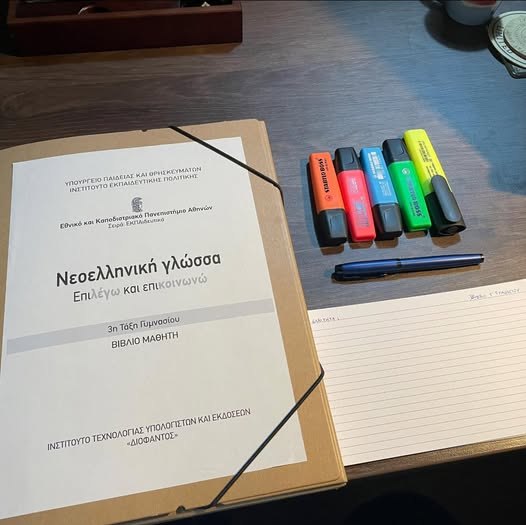
- The featured image shows a draft of the book on my desk. Own work.

Leave a Reply