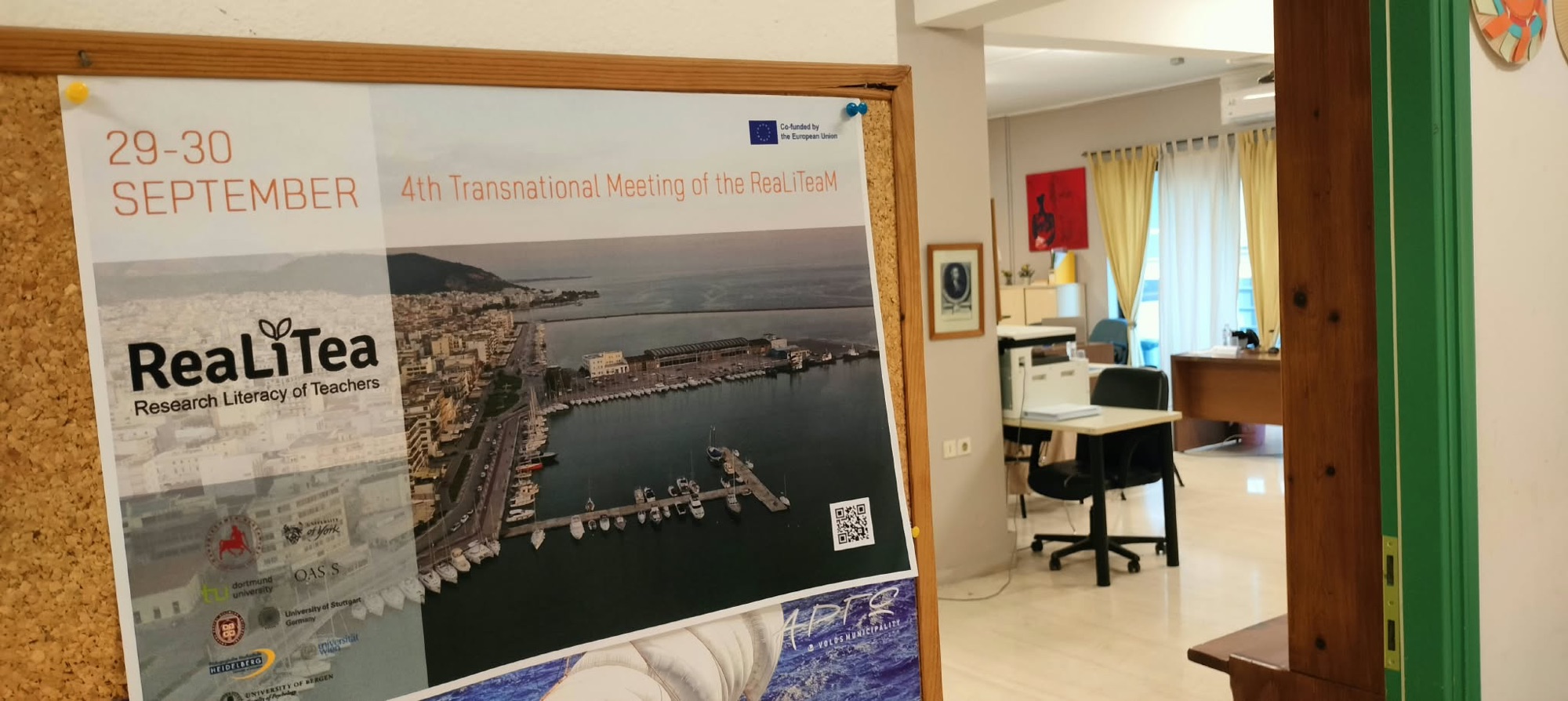
On the 29th and 30th September 2026, we held the final Transnational Meeting of the Research Literacy of Teachers (ReaLiTea) project, this one taking place in Volos. With the project ending at the end of 2026, this was an opportunity for the team to take stock of where we are, and what remains to be done. Many of our resources are near finalisation stage, but in the post that follows, I would like to share a ‘sneak peek’ and invite any feedback you might have, while there is still time to make changes.
The ReaLiTea Community of Practice
We often tend to think of projects in terms of deliverables: pdf files or digital resources, reports and teaching materials. However, what the most successful projects produce is connections between people with similar interests. This is what we have tried to do by setting up the ReaLiTea virtual community of practice.
Built on HumHub, the community is visually similar to many social media platforms.1 There is a central discussion space, where teachers and researchers can share insights and questions about whatever interests them, and around it you can find multiple dedicated spaces with resources on more specific topics, such as Action Research, Inclusion and Diversity, Artificial Intelligence in Language Education, and more.

We envisage the ReaLiTea virtual community of practice as a shared discourse community, where you can share articles you find interesting, pose questions and exchange ideas, find collaborators for classroom-inquiry projects and more. We are also excited about the integration with the OASIS project: the OASIS database2 is creating curated collections of summaries on specific topics, and these will be cross-linked with our discussion spaces, enabling teachers to engage with the articles in the collection in ways that extend beyond passive reading.
We’d love you to take a look, and –if you find our community useful or interesting– maybe join us.
The ReaLiTea Framework
Another major contribution of the ReaLiTea project is the research literacy framework we have been developing. The framework, which builds on the collective expertise of several experts in language teacher education based in Europe, North America and Australia, maps teacher research literacy over several facets (e.g., using research, communicating research, etc.) and levels (from initial to established).
The framework has been around, in different iterations, for quite some time now, and we have already published our attempts to validate it. However, what is new is that we have now created an online tool, which is easier to use and more responsive than a pen-and-paper version.

For the time being, you can find the online self-assessment (or rather its beta version) by clicking on the link below. If you’d like to try it out, you should know that we do not store any of your data or the responses you provide. Based on our initial piloting, I am confident it works reasonably well, but if something unexpected happens as you explore, do let me know.
The ReaLiTea Self-study Materials
Our aim, in the ReaLiTea project, is to empower teachers of second, foreign and additional languages to engage with research (and in research!) more meaningfully. To achieve this, we have created multiple sets of materials for instructed learning and self-study.
For reasons of space, I will only share one set of materials, which focuses on helping teachers become more proficient in using the literature.3 This particular set of materials has been created primarily for self-study, and should be relevant to both practising teachers and students in various stages of their education.
List of Self-Study Modules
- Drawing on published professional knowledge
- Locating relevant knowledge
- Engaging with research articles (and beyond)
- Critical reading and evaluation
- Alternative ways of reading research
Again, the online version of the materials is in beta, which means that there may be occasional errors (if this happens, please let us know). As above, anything you type will only live locally in your browser, and will be lost when the cache is cleared, but you do have the option of storing your responses as a Word file.4
The ReaLiTea User Guide
A less glamorous, but perhaps more important deliverable of the project is the User Guide for the ReaLiTea Materials, which we are now putting together. This short document should help teachers and teacher educators navigate the various materials we have produced over the last three years.
Contents of the User Guide
- What is Teacher Research Literacy
- A definition of Teacher Research Literacy
- Why does Teacher Research Literacy matter
- Using the ReaLiTea materials
- About the ReaLiTea materials
- The ReaLiTea Framework
- Guided instruction materials for teacher educators
- Self-study materials for teachers (reading)
- Self-study materials for teachers (writing)
- The OASIS database
- The community of practice
- Glossary
Over to you
All of the above is still work in progress, and that is precisely why I am sharing it now. With the project drawing to a close at the end of the year, the coming weeks are our last chance to act on what you tell us. So if something is unclear, missing, or simply not as useful as it could be, I would be glad to hear about it, whether in the comments below or in the community itself.
And if you do find something here that helps you in your teaching or your studies, please pass it on to a colleague. The materials will only be as valuable as the use people make of them.


By subscribing to this blog, you will receive occasional updates on topics relating to language education, including my ongoing work on AI in language teaching and learning and on the research literacy of language teachers. (privacy policy)
Notes
- And, if you are close to my age, you might also recognise some of the nicer features of online forums. ↩︎
- In case you are not familiar with their work, OASIS is a dynamic database where you can find one-page summaries of articles that appear in major journals in language and language education. The summaries are written in simple, jargon-free language and are free for everyone to access. At the time of writing (October 2026), the database contains more than 3,000 summaries. ↩︎
- I am using the word ‘literature’ as a short-hand here to describe all forms of professional knowledge that has been made available to teachers in books, academic journals, professional manazines, blogs and podcasts. ↩︎
- Students can also add their name to the word file and submit it as coursework, if you are using these materials in an instructed setting. ↩︎

Inclusion beyond translation: A conversation with Maria Cioé-Peña
What can a teacher do when thirty children bring different languages, cultures, and needs into the same classroom? Drawing on a ReaLiTea podcast, this post considers culturally sustaining pedagogy, multilingual ecologies, multimodal meaning-making, and the unresolved gap between inclusive principles and classroom practice.


Empowering language teachers through AI and research literacies workshop
The joint ReaLiTea and AI Lang workshop took place in Larissa, Greece on 6th December 2025.

Empowering Language Teachers: The Research Literacy Framework
What is language teacher research literacy? In this post, we present an article that defines research literacy and talks about a framework that can designed to support teachers’ professional growth.

About me
Achilleas Kostoulas is an applied linguist and language teacher educator at the Department of Primary Education, University of Thessaly, Greece. He holds a PhD and an MA in Teaching English to Speakers of Other Languages from the University of Manchester, UK and a BA in English Studies from the National and Kapodistrian University of Athens, Greece.
His research explores a wide range of issues connected with language (teacher) education, including language contact and plurilingualism, linguistic identities and ideologies, language policy and didactics, often using a Complex Dynamic Systems Theory perspective to tease out connections between them. Some of his work includes the research monograph The Intentional Dynamics of TESOL (2021, De Gruyter; with Juup Stelma) and the edited volume Doctoral Study and Getting Published (2025, Emerald; with Richard Fay), as well as numerous other publications.
Achilleas currently contributes to several projects that bring together his long-standing interests in language education, teacher development, and the social dimensions of language learning. As the coordinator of the AI Lang (Artificial Intelligence in Language Education) expert team at the European Centre for Modern Languages of the Council of Europe, he is active in developing principles and resources to help educators make informed, pedagogically grounded use of AI in their teaching. He also leads the University of Thessaly team of ReaLiTea (Research Literacy of Teachers), a project that supports language teachers to engage with, and contribute to, educational research. Alongside these, he contributes to LocalLing (Revitalisation of Linguistic Diversity and Cultural Heritage), a Horizon-funded initiative for the preservation of heritage and minority languages globally.
In addition to the above, Achilleas is the (co)editor-in-chief of the European Journal of Education and Language Review, and welcomes contributions that explore the dynamic intersections between language, education, and society.
About this post
This blog is a space for slow, reflective thinking about applied linguistics, language education, professional development, and the role of technology in language teaching and learning. Transparency about process, tools, and authorship is part of that commitment.
- I wrote this post on 6th October 2026. I will periodically revise it to ensure accuracy, so feel free to point out any issues that come to your attention.
- When writing this post, I used artificial intelligence to support copy-editing and Search Engine Optimisation. I wrote the text, and retain responsibility for analytical thinking, authorial decisions and wording.
- The views expressed here are personal and do not necessarily reflect those of the University of Thessaly or any other entity with which I am affiliated.
- The featured image is my own work, featuring a poster prepared by Dimitra Giannouka for the ReaLiTea project.


Leave a Reply