Category: Writing & Publishing
-
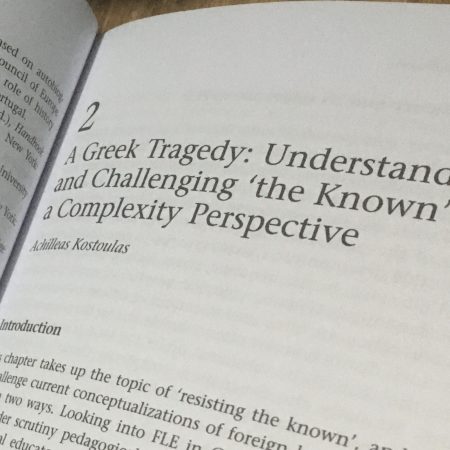
Publishing the ‘Greek Tragedy’ chapter
A step-by-step account of how I published a chapter in an edited collection (Resistance to the Known; Rivers 2014)
-
Open Access Week 2014
To mark Open Access Week 2014, here are some links to relevant content: In this blog An overview of open access publishing; A list of myths about Open Access, according to Peter Suber, the director of the Harvard Office for Scholarly Communication; Elsewhere on the web: A video explaining the Open Access publishing model, by…
-

Presenting multilingual data: Some options
In the previous post of the Researching Multilingually series, I discussed some considerations that impacted the representation of multilingual data. In this post, I follow up on those considerations, by presenting four options that can be used to present multilingual data in a research report. These options, which can be thought of as a ‘cline of representational positions’,…
-
Where can I find calls for papers for TESOL?
So, you have written or are planning to write a paper on language education, TESOL or applied linguistics – but do you know where to publish it? The easiest way forward usually is to submit your work to one of the many journals in the field. Another option is to consider an edited volume or…
-

Possible scam involving academic publishing?
You will never get a fee for publishing in an academic journal. According to a recent post in Scholarly Open Access (a now [2019] defunct blog, which used to report on academic publishing scams), there is at least one academic publisher so keen to recruit authors and editors that they offer rewards of “1,000-10,000 dollars as…
-

Elsevier giving limited free access to new articles
Elsevier have recently announced that they are now providing 50 days of free access to any newly-published article. When an article is published authors are sent a special link, or ‘Share Link’, which they can use in their social media profiles (e.g., Twitter, Facebook, ResearchGate, Mendeley, LinkedIn, etc.). Anyone clicking on the Share Link will…
-

Reviewing your supervisor’s work?
There was a blog post recently over at Peer Review Watch, reporting on a small scale survey among postgraduate students in City University London, regarding their views on peer review. In one of the questions, participants were asked how they would feel about providing peer review for papers submitted by their supervisors. The responses, I am afraid,…
-
How to engage with feedback in a conference presentation
Last week I shared some ideas about how to present a conference paper effectively. In this post, I focus on the discussion session that follows the actual presentation. The discussion is probably the most valuable aspect of presenting a conference paper, as you will get to interact with people whose insights can help to improve…
-

How to avoid desk rejections
Why are some manuscripts rejected before they are even sent out to reviewers? And what can you do to avoid ‘desk-rejections’?