
This post is a brief overview of Critical Skills for Life and Work (CSLW) [link no longer active], one of the last projects in which I was involved at the University of Graz. Although the project has been running since September 2017, I have avoided discussing it in this space, in order to give us time to work out various conceptual and practical issues before inviting critical discussion. After a somewhat challenging birth process, I think that the project has now taken a reasonably good shape, and I feel that it would be a wasted opportunity if I did not share my perspective before I move on.
Contents of this post
The CSLW project
The Critical Skills for Life and Work project is a response to the refugee crisis in Western Europe, and it aims to assist the professional integration of highly skilled migrants and refugees, who often face insurmountable challenges finding gainful employment. Most of the problems they face are, of course, systemic: they stem from the structure of the labour market, possible documentation irregularities, and prejudicial attitudes in the host countries. In our capacity as language educators, we are not really able to do much about these issues, but what we can do, which is potentially beneficial, is help the refugees develop the professional intercultural communication competences that will maximise their opportunities for success, where such opportunities present themselves.
The project, which is funded by the European Union ERASMUS+ framework, is a collaboration of Newcastle University and the Action Foundation in the UK, the Fryske Academy in the Netherlands, and the University of Graz. Locally, it is coordinated by Prof. Sarah Mercer, with assistance from Prof. Beth Erling, myself, the enthusiastic Paige Baralija and the indefatigable David Leersch. In July 2018, Sonja Babić joined the team to replace Paige Baralija, after her resignation.

Who is this project for?
The main beneficiaries of Critical Skills for Life and Work are ‘highly skilled refugees’, a term which is used as a rough synonym to ‘professionals’. However, this seemingly straightforward designation is surprisingly hard to operationalise. An obvious question is whether the term refers to individuals who are highly skilled by employment, highly skilled by competence, highly skilled by education, or any combination of the above. In practical terms, there was broad agreement that our definition includes, say, surgeons and engineers who had to relocate because of war, but could it also include professional athletes or law students whose career trajectories were interrupted? And that did not even begin to address the difficult questions like: Which skills do we value? By whose standards? What exactly is the threshold one needs to meet to be ‘highly skilled’, and is it the same across contexts? In retrospect, it seems that additional discussion in the formative stages of the project would have been helpful, and it is perhaps unfortunate that an inefficient communication structure and exaggerated concerns about ‘tone’ stifled this discussion at the stage when it could have made a difference.

In a series of emails, and most recently at a steering group meeting [link no longer active] that took place in Graz, I insisted on two points. Firstly, our definition should be sensitive to the political implications of distinguishing between ‘highly skilled’ and ‘unskilled’ immigrants. My main concern was that we had to take care not to reproduce and ratify the unacceptable view that refugees are valued only in terms of their potential economic contributions. Secondly, I argued that, whatever criteria we used, these should be unambiguous, transparent and measurable. Rather than reinvent the wheel, I proposed adopting the International Standard Classification of Occupations (ISCO-08) scheme, which is used by statistics agencies worldwide, and therefore had the added benefit of ensuring comparability across the three national sites of research, and multiple countries of refugee origin. The ISCO-08 scheme draws on multiple criteria (formal education, typical tasks, amount of experience and training required) to define four skill levels, and defines ‘professionals’ (level 4) as having tertiary education, being mainly involved in intellectual work, and working in contexts where high literacy and numeracy skills are essential.
It seems that I was not as persuasive as I could have been in making these points, and a decision was reached, instead, in favour of a deliberately ambiguous definition. I believe that this was due partly to a collective reluctance to engage with thorny issues, and partly due to ideologically driven determination to include teachers in our definition of ‘highly-skilled’ refugees (a cynic might argue that as a teacher training unit, we also had a vested interest in developing a definition that could help with followup funding). My objections notwithstanding, the advantage of this approach is that the CSLW materials can, in principle, cater to the needs of an even wider audience than my definition would suggest – in fact, they are addressed to anyone who feels that they may benefit from them.
The CSLW toolkit
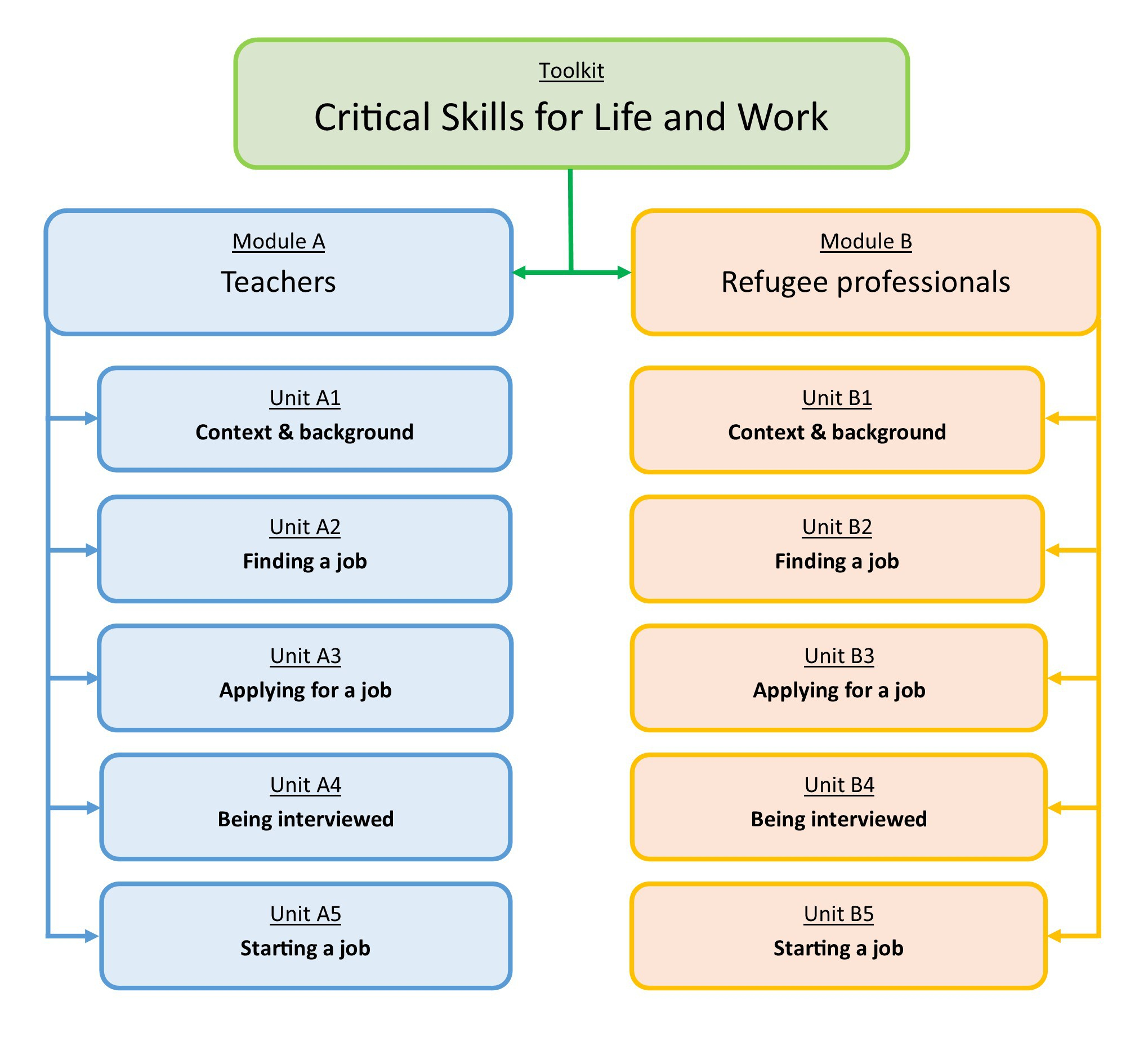
The main deliverable of the Critical Skills for Life and Work project is a toolkit, or set of teaching and learning materials for developing the professional intercultural communication skills of highly skilled refugees. The toolkit consists of two parts, or ‘modules’: one is (to be designed) for self-study and is addressed to refugees themselves; the other is designed for classroom use and is (to be) written with a teacher audience in mind. Each module comprises five units, which focus on different stages of professional reintegration, namely (a) understanding the context, (b) finding a job, (c) applying for a job, (d) being interviewed and (e) starting a job. The activities that make up each unit are the same, or similar, but they are presented with different scaffolding, to cater to the needs of both refugees working autonomously, and teachers who work with refugees. A key principle underpinning the design of the toolkit is flexibility: units can be accessed sequentially or in any other order that is appropriate, and the activities themselves can be used for self-study, differentiated instruction or whole-class teaching.
The language of the toolkit was a matter of considerable debate. From a pragmatic point of view, it made most sense to write the activities in English. On the other hand, one might argue that the refugees would benefit most from additional exposure to the dominant languages of their host countries; and, of course, there are good arguments for challenging the hegemonic role of English. Two points that I was especially keen on incorporating in our rationale were:
- The users of the toolkit should not be treated as if they were linguistically deficient. I felt that it was important to acknowledge that highly skilled migrants must – by definition- be highly literate in the language(s) of their country of origin, and most likely English as well, since this is the lingua franca in international professional communities. I insisted that such pre-existing linguistic capital would have to be acknowledged.
- The toolkit should aim to foster international mobility, not hinder it. This, to me, meant that the primary aim should not be to teach local languages, even though these would doubtless be useful for settling in a particular place. Rather, the priority should be to develop ‘language for mobility’ skills, i.e., skills that would help refugees in any context in which they might find themselves in the future.
Our final decision was based on the assumption that this toolkit aimed to foster intercultural skills, not language development, and therefore a plurilingual approach was the best way forward. In practical terms, this meant that most input would be in English, but the activities would be designed in a way that encouraged communication in any language that was situationally appropriate, and users would be required to make connections with the local discourses. For example, in a typical activity users might be shown an English CV as a prompt, helped by their teacher (possibly in the local language) to locate a similar discipline- and country-specific CV, and discuss the ways in which it is similar and different from the prompt and the CVs they produced in their countries of origin (using English, the local language, their L1s, or – most probably – by mixing these languages). The outcome of such an activity would be a heightened awareness of the context-specific features of a CV, as well as enhanced ability to make themselves understood, using all the linguistic resources in their repertoire.
Where can you find out more about CLSW?
For better or for worse, my own involvement in the project is now at an end, which means that this is probably the last time I will write about it in this space.
However, if you are interested in following its progress, you may want to check out the project website [link no longer active], where updates will be posted regularly. The plan is to have the toolkit ready by February 2019, at which point it should be available for download from the website.
There will also be a series of multiplier events and workshops, which will take place in Graz, Newcastle and the Netherlands in early 2019. If you are around, I am sure the remaining project members will be delighted to welcome you.
By subscribing to this blog, you will receive occasional updates on topics relating to language education, including my ongoing work on AI in language teaching and learning and on the research literacy of language teachers. (privacy policy)

March 2026: Notes on academic collaboration, strain, and scholarly direction
March 2026 was a month dominated by the kick-off meeting of the LocalLing project, perhaps the most important thing I’ve done in my academic life. This is how it unfolded.


Notes from a Book Presentation: Language Politics in Tunisia
A reflection on presenting Language Politics in Tunisia and what Tunisia’s linguistic ecology reveals about language, identity and power.

LocalLing, Week 2
An overview of the second week of the LocalLing meeting in Volos (9th – 12th March 2026). Learning new things, enjoying a book presentation, and taking part in a linguistic landscape walk!
Questions and Answers about CSLW
Who could benefit from the CSLW toolkit?
The toolkit was designed for highly skilled refugees and migrants, i.e., professionals with tertiary education who need to develop intercultural communication competencies for workplace integration. However, the materials were flexible enough to benefit anyone seeking to enhance their professional communication skills.
What made CSLW’s approach different from traditional language learning?
Rather than focusing solely on teaching local languages, CSLW developed “language for mobility” skills and intercultural awareness. It acknowledged users’ existing linguistic capital and used a plurilingual approach, encouraging communication in any situationally appropriate language while building awareness of context-specific professional practices.
Summary
- CSLW was an EU-funded project helping highly skilled refugees and migrants develop professional intercultural communication skills to improve their employment prospects in Western Europe.
- The toolkit features two modules (self-study and classroom-based) covering five career integration stages: understanding context, finding jobs, applying, interviewing, and starting work.
- The project adopted a plurilingual approach using English as the primary language while encouraging users to draw on all linguistic resources and connect with local workplace discourses.
- Activities were designed flexibly to work sequentially or independently, supporting autonomous learning, differentiated instruction, and whole-class teaching.
Other projects
- Research literacy of teachers (ReaLiTea)
- Artificial Intelligence in language education (AI Lang)
- Revitalising Linguistic Diversity and Cultural Heritage (LocalLing)
- Apprentissage des Langues MoDIMEs (ALaMODe)

About me
Achilleas Kostoulas is an applied linguist and language teacher educator at the Department of Primary Education, University of Thessaly, Greece. He holds a PhD and an MA in Teaching English to Speakers of Other Languages from the University of Manchester, UK and a BA in English Studies from the National and Kapodistrian University of Athens, Greece.
His research explores a wide range of issues connected with language (teacher) education, including language contact and plurilingualism, linguistic identities and ideologies, language policy and didactics, often using a Complex Dynamic Systems Theory to tease out connections between them. Some of his work in the field includes the research monograph The Intentional Dynamics of TESOL (2021, De Gruyter; with Juup Stelma) and the edited volume Doctoral Study and Getting Published (2025, Emerald; with Richard Fay), as well as numerous other publications.
Achilleas currently contributes to several projects that bring together his long-standing interests in language education, teacher development, and the social dimensions of language learning. As the coordinator of the expert team of AI Lang (Artificial Intelligence in Language Education), an initiative of the European Centre for Modern Languages of the Council of Europe, he works on developing principles and resources to help educators make informed, pedagogically grounded use of AI in their teaching. He also leads the University of Thessaly team of ReaLiTea (Research Literacy of Teachers), a project that supports language teachers in developing the capacity to engage with, and contribute to, educational research. Alongside these, he contributes to LocalLing, a Horizon-funded initiative to preserve and strengthen heritage and minority languages globally.
In addition to the above, Achilleas is the (co)editor-in-chief of the newly established European Journal of Education and Language Review, and welcomes contributions that explore the dynamic intersections between language, education, and society.
About this post
- I wrote this post in July 2018, shortly before leaving my academic appointment in Graz, as part of the CSLW dissemination strategy. In a revision that took place on 10th January 2026, I updated the layout of the post and engaged in some limited copyediting, without altering the substative content of the post.
- The content of the post does not necessarily reflect the views of the CSLW consortium, the University of Graz or my current employers.
- After the end of the CSLW project, the content of the post does not seem current, and many links have broken. I have chosen to retain this post to document the evolution of my professional thinking.


Leave a Reply